
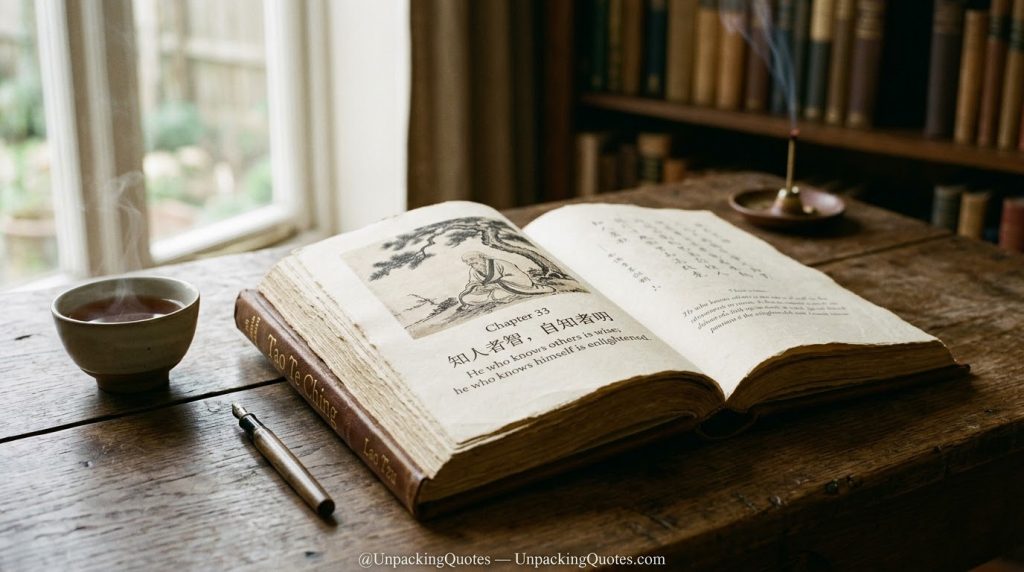
Lao Tzu on Self-Knowledge: The Path to True Wisdom
1. Meaning of the Quote
“He who knows others is wise; he who knows himself is enlightened.”
— Lao Tzu
The quote “He who knows others is wise; he who knows himself is enlightened” expresses a profound distinction between understanding the world around us and understanding the person we are. Observing others can teach us about human nature, relationships, motives, and behavior. But knowing ourselves requires a deeper kind of attention: the willingness to examine our thoughts, emotions, desires, fears, weaknesses, and values honestly. The first kind of knowledge helps us navigate the world; the second helps us understand our place within it.
The word wise suggests the ability to recognize patterns, interpret situations, and make sound judgments. A wise person learns from experience, listens carefully, and develops an understanding of how people behave. Yet even a perceptive observer can misunderstand themselves. We may recognize pride, impatience, or dishonesty in others while failing to notice the same qualities in our own behavior. Understanding other people is valuable, but it does not automatically give us insight into our own character.
The word enlightened points toward a more fundamental awareness. In the philosophical tradition associated with Lao Tzu, enlightenment can be understood as seeing beyond superficial appearances and becoming more deeply aware of the nature of oneself and life. It does not necessarily mean possessing extraordinary knowledge or achieving perfection. Rather, it suggests a clarity that comes from recognizing our own assumptions, accepting reality more fully, and understanding the forces that shape our responses to the world.
Wise versus Elightened
The distinction between these two forms of knowledge is especially important because self-knowledge is not simply a collection of facts about ourselves. We may know our profession, abilities, preferences, and personal history without understanding why we repeatedly make certain choices or react defensively to particular situations. Genuine self-knowledge develops when we begin to recognize the patterns beneath our behavior. It allows us to distinguish between who we believe ourselves to be, who we want others to think we are, and how we actually live.
Consider a person who is highly skilled at reading other people. They can recognize insecurity behind arrogance, fear behind anger, or ambition behind flattering words. Yet if that person cannot acknowledge their own insecurity, anger, or ambition, their understanding remains incomplete. They may use their insight to judge others rather than to improve themselves. The quote challenges this imbalance by suggesting that the deepest understanding begins when we turn the same attention we give to others toward our own inner lives.
Self-knowledge also requires humility. It means accepting that our intentions are not always as pure as we imagine, that our judgments can be distorted by personal interests, and that our memories may reflect our preferred version of events. This recognition is not an invitation to criticize ourselves endlessly. It is an opportunity to see ourselves more clearly, without either exaggerating our virtues or denying our limitations. When we can do this, we become less defensive, more open to correction, and better equipped to make thoughtful decisions.
Ultimately, the quote proposes that understanding others is an important form of intelligence, but understanding ourselves represents a deeper transformation. Knowledge of the outside world can make us perceptive; awareness of our own nature can change how we live. The goal is not to choose between the two, but to recognize that wisdom becomes more complete when it is accompanied by honest self-examination.
2. About the Author: Lao Tzu
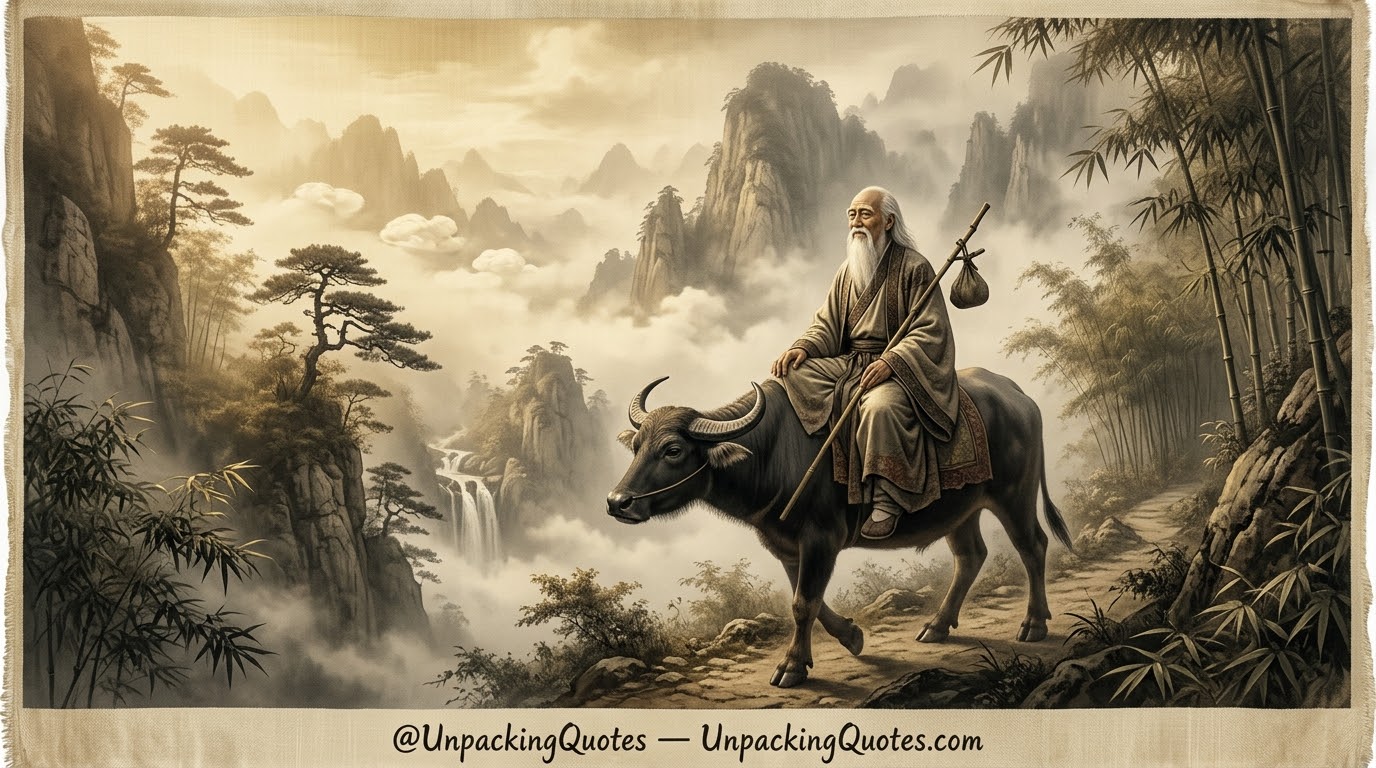
Lao Tzu (Laozi), traditionally dated to the 6th century BCE; historical identity and dates uncertain.
Lao Tzu, whose name is commonly translated as “Old Master,” is the traditional author of the Tao Te Ching, one of the foundational texts of Taoist philosophy. His teachings explore the Tao, or the Way, emphasizing naturalness, simplicity, humility, balance, and an understanding of life that goes beyond rigid assumptions and excessive control.
Lao Tzu's historical identity remains uncertain. Traditional accounts describe him as an ancient sage who lived during the Zhou dynasty and was associated with the royal archives, but scholars cannot confidently establish the details of his life. The Tao Te Ching itself is generally understood in modern scholarship as a text shaped through a process of composition and transmission rather than a work whose entire history can be securely attributed to a single, historically documented individual.
The philosophy associated with Lao Tzu challenges the assumption that greater power, accumulated knowledge, or control over others necessarily produces a better life. Instead, it encourages people to observe the natural patterns of existence, recognize the limitations of their own judgments, and act with greater awareness and restraint. This approach makes self-understanding central to a life of wisdom.
The quote about knowing others and knowing oneself appears in Chapter 33 of the Tao Te Ching, where it is followed by a related distinction: conquering others is associated with strength, while conquering oneself represents a deeper form of strength. The chapter also discusses contentment, perseverance, and endurance. Read in this wider context, the quote is not merely a statement about introspection; it forms part of a broader teaching about self-mastery and the qualities that make a person genuinely strong.
Lao Tzu's enduring influence lies in his invitation to reconsider what it means to be wise. Rather than treating wisdom as the ability to dominate a situation or demonstrate superiority, the Taoist tradition directs attention toward awareness, inner balance, and a less self-centered relationship with the world. His teachings continue to offer a valuable perspective on personal growth, leadership, relationships, and the search for meaning.
3. Historical Context and Culture
The Tao Te Ching emerged from ancient Chinese philosophical traditions concerned with how human beings should live, how society should be governed, and how people might align their actions with the underlying order of existence. Its ideas are closely associated with Taoism, a tradition that places importance on the Tao, commonly translated as “the Way.” The Tao is not simply a set of rules. It refers to the underlying way through which life and the natural world unfold, a reality that human understanding can approach but never completely reduce to rigid definitions.
The period associated with the formation of early Taoist thought was marked by political instability, competing states, and debates about effective government and ethical conduct. Thinkers across ancient China sought ways to understand disorder and identify principles for a more harmonious life. The Tao Te Ching offers a distinctive response: instead of relying exclusively on force, ambition, or elaborate systems of control, it emphasizes simplicity, restraint, adaptability, and an understanding of the limits of human authority.
Within this philosophical setting, self-knowledge carries a significance beyond ordinary introspection. To know oneself is to recognize one's impulses, attachments, and assumptions, and to understand how the ego can interfere with a clear perception of reality. The text repeatedly questions the belief that outward achievement or the ability to impose one's will on others is the highest expression of strength. Its alternative is a more disciplined and balanced relationship with oneself and the world.
Chapter 33 develops this perspective through a series of contrasts. Knowing others is associated with wisdom, while knowing oneself is associated with enlightenment. Overcoming others is contrasted with overcoming oneself, and the chapter proceeds to connect contentment with wealth and perseverance with purpose. These ideas belong together: a person who understands their own desires and limitations is better positioned to distinguish genuine needs from endless striving and meaningful action from the impulse to control everything.
It is important, however, to distinguish the ancient teaching from any single modern English formulation. The Chinese text begins this passage with the words 知人者智,自知者明. Translators have rendered the contrast in different ways, using terms such as “wise,” “clever,” “intelligent,” “discernment,” and “enlightened.” These variations reflect the interpretive choices involved in translating a classical text into a modern language. The central contrast between understanding other people and gaining insight into oneself remains recognizable across these versions.
The quote's historical importance therefore lies not only in its memorable wording but also in its place within a larger philosophy of self-mastery. It invites readers to reconsider conventional measures of intelligence, strength, and success. In the Taoist perspective, a person's relationship with their own mind and impulses may reveal more about their wisdom than their ability to understand, influence, or defeat others.
4. Relevance Today
In modern life, understanding other people is often treated as a competitive advantage. We study communication, psychology, negotiation, leadership, and social behavior to become more effective in our careers and relationships. These skills can be valuable, but the quote reminds us that outward understanding is only part of the picture. We can become highly skilled at interpreting other people's behavior while remaining unaware of the assumptions and emotions that influence our own decisions.
Self-knowledge is particularly relevant in a world shaped by constant comparison and external validation. Social media encourages people to measure themselves against carefully selected images of other people's lives. Professional environments may reward confidence, achievement, and visible success, sometimes leaving little room for reflection. In these circumstances, it becomes easy to confuse the identity we present to the world with the person we actually are. The quote encourages us to look beyond appearances and ask whether our choices reflect our genuine values or our desire for approval.
In relationships, the distinction is equally important. We may be quick to identify a partner's impatience, a friend's defensiveness, or a colleague's need for recognition. Yet resolving conflict requires us to examine our own contribution. Are we listening to understand, or waiting to defend ourselves? Are we reacting to what the other person actually said, or to a fear or past experience that their words have awakened? Greater self-awareness does not mean accepting blame for everything. It means recognizing the parts of a situation over which we have genuine influence.
The quote also has practical implications for leadership. A leader who understands other people but lacks self-awareness may recognize the weaknesses of a team while overlooking their own tendency to micromanage, dismiss criticism, or reward agreement over honesty. By contrast, a leader who understands their strengths and limitations can make better use of feedback, acknowledge mistakes, and create conditions in which others can contribute more effectively. In this sense, self-knowledge is not a retreat from responsibility; it is a foundation for exercising responsibility well.
Personal growth offers another application. People often seek change by acquiring more information, adopting new routines, or pursuing external achievements. Those efforts can help, but lasting change also requires understanding why familiar patterns persist. Someone who repeatedly abandons important goals, for example, may need to examine fear of failure, unrealistic expectations, or a habit of seeking immediate comfort. Recognizing these patterns creates the possibility of responding differently instead of repeating the same cycle.
Finally, the quote remains relevant because self-knowledge is an ongoing process rather than a destination. Our priorities change, new experiences challenge our beliefs, and circumstances reveal aspects of our character that we had not previously recognized. Genuine insight therefore requires curiosity and a willingness to revise our self-image. The more honestly we examine ourselves, the less dependent we become on the need to appear right, successful, or superior.
The modern lesson is clear: understanding others can help us navigate the world, but understanding ourselves helps us decide how we wish to move through it. The two forms of knowledge reinforce each other. When self-awareness accompanies our understanding of others, we become better equipped to respond thoughtfully rather than react automatically, to learn rather than defend, and to build relationships grounded in honesty rather than assumption.
5. Summary
Lao Tzu's saying distinguishes between the wisdom gained by understanding other people and the deeper insight that comes from understanding oneself. Observing others teaches us about human nature, but self-knowledge reveals the assumptions, desires, fears, and habits that influence our own behavior. Without this inner awareness, even considerable intelligence can leave us blind to our own limitations.
The quote invites us to treat self-examination as a form of strength rather than a sign of weakness. Recognizing our mistakes, questioning our assumptions, and acknowledging uncomfortable truths can help us make wiser decisions and develop healthier relationships. The goal is not to achieve perfect knowledge of ourselves, but to become more honest, aware, and willing to grow.
Ultimately, the teaching reminds us that wisdom is not measured only by how much we know about the world or how well we understand other people. It is also reflected in our ability to see ourselves clearly and act with greater awareness. The journey toward understanding life begins, in part, with the courage to understand the person looking back at us.
Explore Similar Quotes
Browse the Author Collection
Practicing the Wisdom of the Quote:
“He who knows others is wise; he who knows himself is enlightened.”
— Lao Tzu
Understanding ourselves is not something we accomplish simply by thinking about who we are. Self-knowledge develops through observation, reflection, and the willingness to learn from our behavior. It requires us to look beyond the explanations we habitually give ourselves and examine what our actions reveal. The following practices translate Lao Tzu's teaching into habits that can be incorporated into everyday life.
Practice 1: Observe Yourself Without Judgment
When a strong emotion arises, pause before reacting. Notice what you are feeling, what triggered it, and what you are tempted to do in response. Rather than immediately labeling the emotion as good or bad, approach it as information about your present state of mind.
For example, if a colleague criticizes your work and you feel angry, ask yourself whether the anger comes from the criticism itself, the way it was delivered, or a fear that your competence is being questioned. This distinction can help you respond to the actual situation instead of allowing an automatic reaction to determine your behavior.
Daily exercise: At the end of the day, recall one moment when you reacted strongly. Identify the trigger, your emotional response, and one alternative response you could have chosen.
Practice 2: Recognize Your Blind Spots
We are often better at recognizing other people's weaknesses than our own. This happens partly because we experience our intentions from the inside but observe other people's actions from the outside. We know why we believe we acted as we did, while the motives of others may be less apparent to us.
To challenge this imbalance, consider a criticism you have received more than once. Instead of immediately rejecting it, ask whether there might be a pattern worth examining. Repeated feedback does not automatically mean that others are correct, but it can reveal something you have not yet considered.
Daily exercise: When you feel tempted to criticize someone, ask yourself: “Is there any part of this behavior that I recognize in myself?” The purpose is not to accuse yourself, but to become more perceptive and fair.
Practice 3: Separate Your Identity From Your Ego
Many people unconsciously build their identity around being intelligent, successful, generous, independent, or always right. When an experience threatens that identity, they may become defensive or refuse to acknowledge a mistake. The desire to protect an image can prevent them from seeing reality clearly.
Self-knowledge becomes easier when we accept that our qualities do not need to be absolute. A capable person can make poor decisions. A generous person can sometimes act selfishly. A confident person can feel insecure. Recognizing these contradictions does not erase our strengths; it gives us a more realistic understanding of ourselves.
Daily exercise: The next time you make a mistake, replace “I must not appear wrong” with “What can I learn from this?” Focus on correcting the mistake rather than defending your image.
Practice 4: Examine Your Motivations
Our actions can have several motives at once. We may help someone because we care about them, but also because we want to be appreciated. We may pursue success because we value achievement, but also because we fear being considered inadequate. Mixed motives are part of human experience; recognizing them is more useful than pretending they do not exist.
Before making an important decision, take a moment to examine what is driving you. Ask whether you are acting from your values, fear, habit, resentment, ambition, or the desire for approval. You may discover that an apparently obvious choice becomes more complicated when you understand what you truly want from it.
Daily exercise: Before one meaningful decision each day, ask yourself: “If nobody praised me, criticized me, or even knew about this choice, would I still make it?” Your answer can help clarify your priorities.
Practice 5: Learn From the Gap Between Intention and Impact
We tend to judge ourselves by our intentions and other people by the effects of their actions. Yet good intentions do not guarantee good outcomes. We may believe we are helping while making someone feel controlled, or believe we are being honest while communicating without consideration.
Self-knowledge requires us to pay attention to the difference between what we meant to do and what actually happened. This does not mean allowing others to define our character. It means being willing to consider the consequences of our behavior and make adjustments when necessary.
Daily exercise: After an important conversation, ask yourself two questions: “What was I trying to communicate?” and “How might the other person have experienced it?” Use the difference to improve your next interaction.
Practice 6: Create a Regular Moment of Honest Reflection
Modern life offers countless opportunities to gather information but comparatively few moments of quiet reflection. Without time to process our experiences, we may repeat familiar behaviors without understanding why. A brief daily review can help turn ordinary experiences into meaningful lessons.
Choose a consistent time when you can sit quietly without distraction. Consider what went well, where you reacted automatically, and what you learned about yourself. Avoid turning the exercise into a list of failures. The objective is to observe your life accurately, including your progress and strengths.
Daily exercise: Spend five minutes answering these three questions:
- What did I learn about myself today?
- When did my actions reflect my values, and when did they fall short?
- What is one thing I can do differently tomorrow?
Bringing the Wisdom Into Everyday Life
The purpose of these practices is not to make you constantly analyze yourself. Excessive introspection can become another form of self-absorption. The goal is to develop enough awareness to recognize your patterns, take responsibility for your choices, and respond to life's challenges with greater clarity.
Self-knowledge grows through small, repeated acts of honesty. Each time you question an assumption, acknowledge a mistake, or choose a thoughtful response over an automatic reaction, you put the quote into practice.
Remember: You do not need to understand yourself perfectly to begin living more wisely. You need only to remain willing to look honestly at what your experiences reveal.
The Quiet Mirror
An original poem inspired by Lao Tzu's on wisdom and self-knowledge.
I watched the world with searching eyes,
Read hidden storms in others' skies,
Could trace the roots of others' pain,
Yet missed the wounds I kept concealed within.
I knew the masks that others wore,
The battles fought behind each door,
Could name the fears that shaped their ways,
But not the doubts within my own gaze.
Then silence came, without a sound,
And turned my restless vision round.
No stranger stood before me there,
Just all the truths I feared to bear.
I saw my pride, my need to win,
The walls I built to hide within,
The fears that dressed themselves as pride,
The truths I pushed away to hide.
And slowly, what I feared to see
Became the path that set me free.
For wisdom is not just what we know,
But what we dare to face and grow.
The world may teach us how to see,
But truth begins with honesty.
And when we meet ourselves with care,
A deeper light begins to appear.
No crown is won, no prize bestowed,
No map reveals the final road.
Just one more truth, one veil made clear,
One step beyond the edge of fear.
So let me seek, not just what's known,
But understand the seeds I've sown.
For all the wisdom I pursue
Begins with seeing what is true.