

Epictetus on choosing how we respond to circumstances
“We cannot choose our external circumstances, but we can always choose how we respond to them.”
— Attributed to Epictetus
1. Meaning of the Quote
The quote expresses one of the central principles of Stoic philosophy: our freedom does not depend entirely on controlling what happens to us; it depends on how we use our judgment and choose to act in response to what happens.
Life constantly places circumstances beyond our control in front of us. We cannot determine every event, prevent every disappointment, control other people’s decisions, or guarantee particular outcomes. Epictetus begins his Enchiridion by making precisely this distinction: some things are within our power, including our judgments, desires, aversions, and actions, while other things—including our possessions, reputation, position, and many external events—are not.
The important point is that “response” does not simply mean having a positive attitude. For Epictetus, it means exercising judgment. An event may be painful, disappointing, frightening, or unfair, but there remains a difference between the event itself and the judgment we make about it. His philosophy asks us to examine that judgment before allowing an external event to determine our inner state or our next action.
This does not mean that circumstances are irrelevant or that people should passively accept injustice, loss, illness, or hardship. Stoicism instead asks us to distinguish what we can influence from what we cannot. We can prepare, act, resist, speak, help, change course, and make responsible choices—but we cannot guarantee the final outcome.
That distinction can transform the way we face difficulty. Instead of asking only, “Why is this happening to me?”, we can also ask, “Given that this is happening, what is within my power now?”
The answer may be surprisingly small: choosing our words, controlling an impulse, making a difficult decision, refusing to surrender our principles, or taking the next useful action. Yet those small choices are precisely where Epictetus locates human agency.
The deeper Stoic idea
The deeper message is not “You control your life.” It is almost the opposite.
You control far less of life than you might wish, but what remains genuinely yours—your judgment and your choices—matters enormously.
That is why this philosophy can be understood as a discipline of freedom. External circumstances can restrict our options, but they do not automatically determine the quality of the judgment with which we meet those circumstances. The Internet Encyclopedia of Philosophy notes that, for Epictetus, our ultimate power lies in adapting ourselves to what occurs and maintaining the integrity of our character rather than treating external outcomes as entirely ours to command.
2. About Epictetus
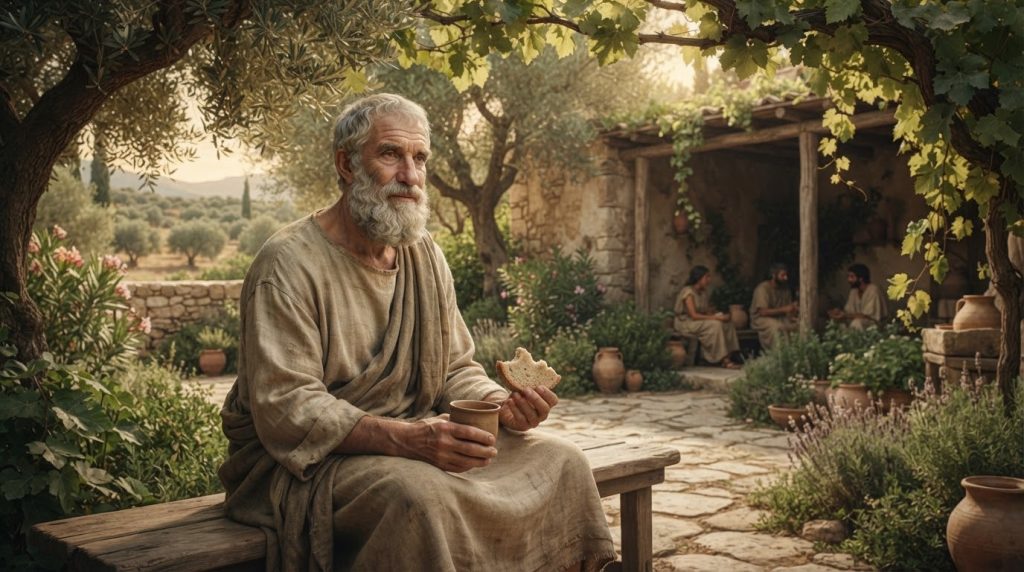
Epictetus (c. 50–135 CE) was a Greek Stoic philosopher who spent part of his early life enslaved in Rome before becoming a teacher of philosophy. After gaining his freedom, he established a philosophical school and eventually taught in Nicopolis in northwestern Greece.
Unlike philosophers whose surviving works consist primarily of systematic treatises, Epictetus is known through the writings of his student Arrian, particularly the Discourses and the shorter Enchiridion, or Handbook. His philosophy centered on practical ethical training: learning to distinguish what belongs to our agency from what does not and developing the character necessary to respond wisely.
His circumstances make the philosophy especially striking. Epictetus did not develop his teaching from a position of complete external security. His philosophy repeatedly returns to the question of what remains genuinely ours when circumstances are not ours to command.
For him, freedom was fundamentally an ethical and psychological achievement: the ability to govern one’s own judgments and choices rather than making one’s well-being dependent upon things controlled by fortune or by other people.
3. Historical Context and Culture
Epictetus lived during the Roman Imperial period, when Stoicism had developed from the earlier Greek school founded by Zeno of Citium into a major philosophical tradition in the Greco-Roman world.
Stoicism was not merely an intellectual theory. It was intended as a way of life. Philosophical training involved examining one’s judgments, disciplining desires and aversions, and learning how to behave virtuously regardless of changing circumstances.
The distinction between what is “up to us” and what is not up to us stands at the beginning of Epictetus’s Enchiridion. In one translation, he identifies opinions, desires, aversions, and our own actions as belonging to us, while placing the body, possessions, reputation, public position, and other external matters outside our complete control.
This distinction was especially important within Stoic ethics because the Stoics did not define a good life simply by external success. Wealth, status, reputation, health, and comfort could be desirable, but they were not what ultimately constituted moral excellence.
The central question therefore became:
What kind of person are you going to be, given the circumstances you have been given?
That is the philosophical foundation beneath the modern wording of this quote.
4. Relevance Today
The quote has particular relevance in a world in which people are constantly exposed to events they cannot directly control.
Economic uncertainty, workplace changes, relationship difficulties, criticism, social-media reactions, unexpected setbacks, and countless other events can consume enormous amounts of attention. The Stoic distinction provides a practical filter: What part of this situation is actually mine to act upon?
Consider criticism. You cannot completely control what another person thinks or says about you. You can, however, examine whether the criticism contains something useful, decide whether to respond, and choose how to conduct yourself.
The same principle applies to failure. You cannot retroactively change an outcome, but you can determine whether you learn from it, repeat the same mistake, or make a different choice next time.
And it applies to success as well. Even a successful outcome contains elements beyond our control—timing, other people’s decisions, circumstances, and chance. The Stoic discipline therefore keeps attention on the quality of one’s actions rather than becoming completely dependent upon external validation.
This makes the quote less about positive thinking and more about responsible agency.
5. Summary
The quote teaches a deceptively simple lesson:
We do not have complete authority over what happens to us, but we retain responsibility for how we meet what happens.
Epictetus’s philosophy does not promise that choosing the right response will make difficult circumstances disappear. Instead, it identifies a smaller but more reliable sphere of freedom: our judgments, choices, intentions, and actions.
The wisdom lies in refusing to waste our agency trying to command what cannot be commanded—and using that agency fully where it genuinely exists.
Explore Similar Quotes
Browse the Author Collection
Practicing the Wisdom of the Quote
The Stoic Pause
When something upsetting happens, pause before reacting.
Ask yourself:
- What exactly happened?
- Which part of this situation is outside my control?
- What part is within my control?
- What response would be consistent with the person I want to be?
- What is the next action that is actually mine to take?
This simple sequence separates the event from your judgment about the event and your choice of action.
Practice: Change the Question
Instead of asking:
“How do I make this situation turn out the way I want?”
try asking:
“What can I do well, regardless of how this turns out?”
That shift does not eliminate uncertainty. It moves your attention from controlling the uncontrollable to exercising the agency you actually possess.
A Daily Reflection
At the end of the day, consider one difficult situation you encountered.
Write down:
The circumstance: What happened?
What was not mine: What could I not control?
What was mine: What could I control?
My response: What did I choose?
Tomorrow: What would I do differently?
Over time, this practice can make the distinction between circumstance and response more instinctive.
Poetry & Lyrics Inspired by the Quote
What Remains Mine
The wind does not ask
which way I want it to blow,
nor does the road promise
where it will lead.
Some doors will close
before I am ready.
Some answers will never come.
Some hands will let go.
I cannot command the weather,
the passing of time,
the words of another,
or the turning of fate.
But I can choose
whether I meet the storm
with bitterness or courage,
with fear or understanding.
I can choose my step
when I cannot choose the road.
I can choose my words
when I cannot choose another’s silence.
And when the world
moves beyond my reach,
I will return to what remains:
my judgment,
my courage,
my next action—
the small, quiet freedom
that is still mine.