
Site logo
    • Explore Inspiring Quotes
    • About UnpackingQuotes.com
    Sign in
    The Power of Questions: What Socrates Really Meant by “I Cannot Teach Anybody Anything”

    The Power of Questions: What Socrates Really Meant by “I Cannot Teach Anybody Anything”

      • Unpacking the Quote
      • Practicing the Wisdom
      • Poetry & Lyrics
      • prev
      • next
      • Bookmark
      • Share
      • prev
      • next

      The Power of Questions: What Socrates Really Meant by “I Cannot Teach Anybody Anything”

      “I cannot teach anybody anything. I can only make them think.”
      — Commonly attributed to Socrates

      There is something deceptively simple about this sentence. At first glance, it seems to diminish the role of the teacher. But understood in the context of Socrates’ philosophy, it does almost the opposite: it presents teaching as something deeper than transferring information. A teacher may provide knowledge, explanations, examples, and guidance—but genuine understanding must ultimately be discovered by the learner.

      One important clarification belongs at the beginning of any serious examination of this quotation: the exact wording is not found in the surviving works of Plato or Xenophon. It is best treated as a modern formulation or paraphrase of ideas strongly associated with Socrates, rather than as a verbatim ancient quotation. The connection is nevertheless substantial: in Plato’s Apology, Socrates explicitly rejects the claim that he is a conventional teacher, while in the Meno he develops ideas about questioning, discovery, and learning that closely resemble the sentiment expressed here. 

      1. Meaning of the Quote

      The heart of the quotation is the distinction between being told something and understanding something.

      A person can give us facts, but no one can simply place understanding inside our minds. We may hear an explanation, memorize an answer, or repeat someone else’s wisdom, yet still fail to truly comprehend it. Real learning begins when we actively engage with an idea, question it, examine it, challenge our assumptions, and eventually arrive at understanding for ourselves.

      This is why the second half of the quotation is so important: “I can only make them think.” Socrates’ role is not to fill an empty mind with ready-made answers. His role is to disturb certainty, expose contradictions, awaken curiosity, and encourage another person to investigate.

      A good question can sometimes accomplish more than a good answer.

      When someone gives us an answer, we may remember it. When someone makes us think, we may discover something that becomes part of the way we understand the world.

      The quotation therefore offers a profound definition of education: the purpose of teaching is not merely to provide answers, but to develop the capacity to seek, examine, question, and discover answers.

      It also contains a lesson about intellectual humility. If we assume that we already know everything worth knowing, there is little reason to investigate. But recognizing the limits of our knowledge creates the space in which genuine learning becomes possible.

      Socrates’ famous approach was therefore less about saying, “Here is the truth; memorize it,” and more about asking, “What do you mean? Why do you believe that? Does your reasoning hold together? What follows if we examine that assumption?”

      The question becomes the doorway through which understanding enters.

      2. About the Author and Key Biographical Points

      Socrates (c. 469–399 BCE) was an Athenian philosopher whose influence on Western thought is difficult to overstate. Unlike Plato and Aristotle, Socrates left no philosophical writings of his own. What we know of him comes principally through later accounts, especially those of Plato and Xenophon, along with the comic portrayal of him by Aristophanes. Because these sources differ, separating the historical Socrates from the literary character created by his followers and critics remains a major philosophical and historical problem. 

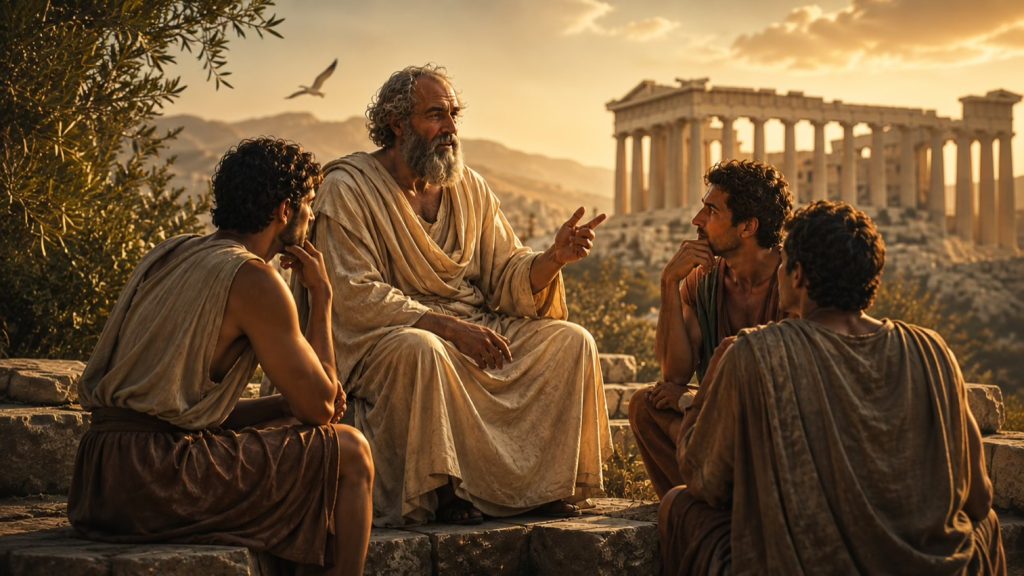
      Socrates spent much of his life engaging people in conversation about subjects such as justice, virtue, knowledge, courage, and the good life. Rather than establishing a formal school in the conventional sense, he questioned people in the public life of Athens.

      He also refused to present himself as a professional educator. In Plato’s Apology, Socrates rejects the accusation that he is a teacher who takes money, distinguishing himself from the Sophists who offered instruction for payment. He says that people are free to come and listen to him, but he denies having taught them in the ordinary sense. 

      This makes the quotation particularly interesting. Although the precise sentence is probably not ancient, its underlying idea is remarkably compatible with Socrates’ own description of his philosophical mission.

      Socrates was eventually tried and condemned to death in Athens in 399 BCE. His willingness to continue examining questions of truth, justice, and virtue—even when doing so placed him in conflict with his society—helped make his life itself part of his philosophical legacy. 

      3. Historical and Cultural Context

      To understand Socrates, we need to understand fifth-century Athens.

      Athens was a city deeply invested in public debate, political participation, rhetoric, and civic life. Sophists and rhetoricians offered instruction to young men who wanted to become effective speakers and participants in public affairs. Education could therefore involve learning how to argue, persuade, and succeed within the political and social structures of the city. 

      Socrates represented a different kind of intellectual activity.

      He was less interested in teaching people what to think than in examining how they thought.

      This approach became associated with what we now call the Socratic method: systematic questioning designed to examine beliefs, uncover contradictions, clarify concepts, and stimulate independent reasoning. OpenStax describes Socrates’ characteristic practice as asking questions rather than simply explaining his own beliefs. 

      Plato’s Meno provides one of the clearest illustrations. Socrates questions a young slave boy about geometry rather than simply giving him the answer. Through a sequence of questions, the boy works through the problem himself. The dialogue connects this process with Socrates’ theory of recollection, but its educational implication is broader: the learner must participate actively in the discovery of understanding. 

      This is precisely where the quotation’s deeper meaning emerges.

      Socrates did not necessarily believe that another person could do the intellectual work for us. Someone can guide the search, challenge our assumptions, and point toward a problem—but the act of understanding remains our own.

      The teacher can open the door.

      We must walk through it.

      4. Relevance Today

      More than two thousand years later, the quotation may be even more relevant because we live in an age of unprecedented access to information.

      We can find an answer to almost any factual question within seconds. Artificial intelligence, search engines, online courses, videos, books, podcasts, and social media provide an extraordinary quantity of information.

      Yet information and understanding are not the same thing.

      The challenge today is increasingly not “How can I find an answer?” but “How do I know whether this answer is sound?”

      That makes Socratic thinking particularly valuable.

      Instead of immediately accepting a claim, we can ask:

        • What exactly does this mean?
        • What evidence supports it?
        • What assumptions are hidden inside it?
        • What would contradict it?
        • Am I agreeing because it is true—or because I want it to be true?
        • What might I be missing?

      These questions are useful in education, relationships, leadership, business, politics, science, and everyday decision-making.

      They are also useful internally.

      Sometimes the most important questions are the ones we ask ourselves.

      Why am I afraid of this?
      Why do I believe I cannot change?
      What evidence do I actually have?
      Am I reacting to reality—or to my interpretation of reality?
      What would I think if I were willing to question my own assumptions?

      The Socratic approach does not promise easy answers. It offers something more valuable: a stronger mind with which to search for them.

      5. Summary

      Socrates’ message is not that teaching is useless. It is that true learning cannot be reduced to the transmission of information.

      A teacher can explain. A mentor can guide. A book can introduce an idea. A conversation can challenge us. But understanding becomes genuinely ours only when we engage with the idea ourselves.

      The quotation therefore shifts our understanding of education from instruction to awakening.

      The greatest teacher may not be the person who gives us the most answers, but the person who leaves us with better questions.

      And perhaps that is why Socrates remains so influential. He did not simply ask people to acquire more knowledge. He challenged them to examine the knowledge they thought they already possessed.

      Meet the Thinker

      Socrates Biography | Athenian philosopher

      Explore Similar Quotes

      • Wisdom & Life Lessons
      • Mind & Perspective
      • Personal Growth

      Discover More Quotes

      • Thinking
      • Learning
      • Education
      • Knowledge
      • Awareness
      • Independent thinking
      • Self-discovery

      Browse the Author Collection

      • Socrates

      Practice & Application

      The easiest way to apply this quotation is to replace the habit of immediately seeking answers with the habit of first asking better questions.

      When you encounter an important idea, don’t simply ask, “What is the answer?” Ask, “How can I understand this for myself?”

      When someone gives you advice, explore the reasoning behind it. When you disagree with someone, ask what assumption produces the disagreement. When you make a mistake, don’t stop at “What went wrong?” Ask, “What did this experience reveal that I didn’t understand before?”

      You can also practice Socratic thinking in your own daily decisions. Before accepting one of your strongly held beliefs, challenge yourself to explain why you believe it. Then deliberately look for evidence that could prove you wrong.

      And when teaching someone else—especially a child—resist the temptation to provide every answer immediately. Ask questions that help them reason their way toward an answer.

      Instead of saying, “This is how you do it,” try asking, “What do you think would happen if we tried this?”

      Instead of correcting immediately, ask, “What makes you think that?”

      Instead of ending a conversation with an answer, sometimes leave the person with a question worth thinking about.

      The objective is not to make people dependent upon our knowledge.

      It is to help them develop their own.

      A Poem Inspired by the Quote

      The Question

      Do not give me every answer,
      leave a question in my hands;
      let me turn it in the silence,
      let me see where understanding stands.

      Do not tell me where the road ends,
      teach me how to read the sky;
      give me courage to keep walking,
      and the freedom to ask why.

      A thought awakened from within
      is worth more than words repeated;
      truth becomes a deeper thing
      when by our own search it is completed.

      So ask me what I cannot see,
      challenge what I think I know;
      let uncertainty become the seed
      from which wiser questions grow.

      For knowledge may be handed down,
      but wisdom asks us to participate.

      And sometimes the greatest teacher
      is not the one who tells us what is true—

      but the one
      who makes us
      think

      You May Also Be Interested In

      Luck is what happens when preparation meets opportunity

      The Happiness of Your Life Depends Upon the Quality of Your Thoughts

      Whoever fights monsters should see to it that in the process he does not become a monster

      The Philosophy of Enough: Unpacking Epicurus on Gratitude and Contentment

      Fear of the Truth: Why We Prefer the Safety of the Shadows

      “He Who Has a Why to Live…” — Nietzsche on Purpose and Meaning

      Do Not Pray for Easy Lives: Pray for the Strength to Meet Your Tasks

      The Wisdom of Changing Yourself Before Changing the World | Rumi

      We Are What We Repeatedly Do: Excellence as a Habit | Aristotle

      Happiness Is Not by Chance, but by Choice: The Power of Choosing How We Live

      You can lead a horse to water, but you can’t make him drink — English proverb

      What Is Culture? Understanding “Culture Is What Remains When One Has Forgotten Everything”

      To Keep Your Balance, You Must Keep Moving.” — Albert Einstein

      Not All Storms Come to Disrupt Your Life: Meaning, Lessons & How to Find the Path Forward

      “We Suffer More Often in Imagination Than in Reality” — Seneca: Meaning, Stoic Wisdom & How to Stop Overthinking

      Sorrow and Joy | Kahlil Gibran, The Prophet (1923)

      There is Only One Way to Happiness—Epictetus

      Whenever you Find Yourself on the Side of the Majority—Mark Twain

      All quote explanations, interpretations, practices, applications, lyrics, poems, and original creative works published on UnpackingQuotes.com are protected by copyright.

      The lyrics and poems inspired by the ideas, themes, and wisdom of the quotes are original creative works of UnpackingQuotes.com unless otherwise stated.

      © Unpacking Quotes 2026 - All rights reserved
      Unpacking the Quote. Practicing the Wisdom. Creating the Lyrics.

        • Facebook
        • X
        • WhatsApp
        • Viber
        • Telegram
        • Pinterest
        • LinkedIn
        • Tumblr
        • Reddit
        • VKontakte
        • Mail
        • Copy link
        • Share via...
        • Threads
        • Bluesky