

Epictetus: “Men Are Disturbed Not by Things, but by Their Views”
“Men are disturbed not by things, but by the views which they take of things.”
— Epictetus, Enchiridion, 5
1. Meaning of the Quote
“Men are disturbed not by things, but by the views which they take of things” expresses one of the central insights of Stoic philosophy: an external event and our judgment about that event are not the same thing. Epictetus argues that what troubles us is often not simply what happens, but the meaning, interpretation, or judgment we attach to what happens.
The distinction is subtle but powerful. Two people can encounter the same circumstance and experience very different emotional responses because they interpret it differently. A difficult conversation, a failure, criticism, an unexpected change, or a loss may be unpleasant in itself, but the intensity and character of our distress can be shaped by the conclusions we draw from it.
Epictetus is not saying that external events are imaginary or that painful circumstances do not matter. Rather, he is directing attention toward the part of the experience over which we have greater influence: our judgment about what has happened and how we choose to respond.
The remainder of Chapter 5 makes this point through the example of death. Epictetus says that death itself is not what produces terror; rather, it is our judgment that death is terrible. He then turns the principle toward everyday frustration, arguing that when we are disturbed or grieved, we should examine our own views instead of automatically assigning responsibility to others.
The Stoic Lesson
This does not mean that every negative experience is simply a matter of “changing your mindset.” Some events genuinely involve pain, injustice, loss, danger, or hardship. The Stoic lesson is more precise: even when we cannot control what has happened, we can examine the judgments we make about it and work toward responding deliberately rather than being completely governed by our first reaction.
The quote therefore shifts the question from “Why is this happening to me?” toward “What am I telling myself about what is happening?” That shift can create a space between an event and our response—a space in which reflection, judgment, and choice become possible.
2. About the Author — Epictetus
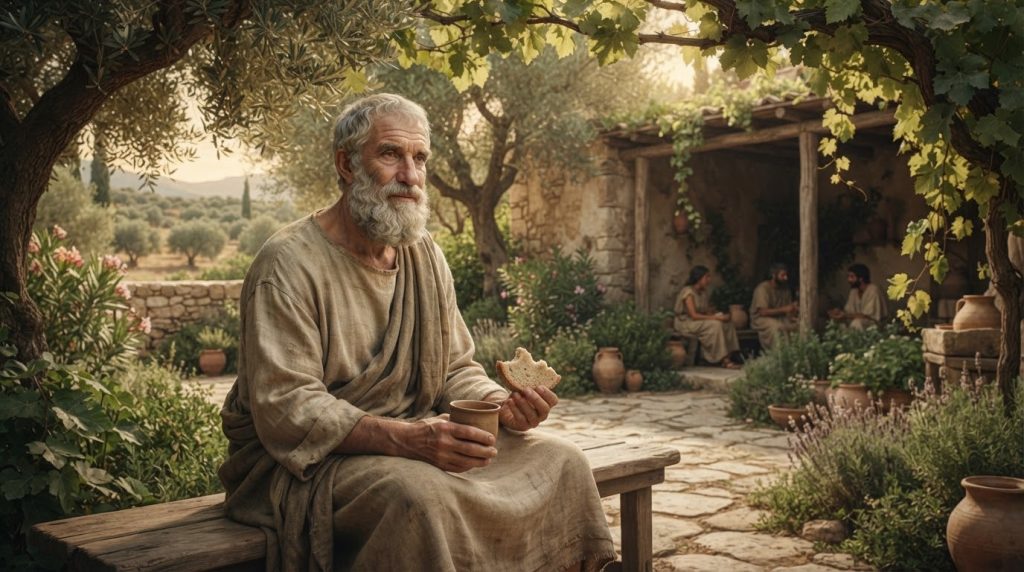
Epictetus was a Greek Stoic philosopher who lived approximately from the mid-first to the early second century CE. He taught that philosophy was not merely a body of theories to be discussed but a discipline to be practiced in everyday life.
His teachings emphasize the distinction between what is within our control and what is not, the importance of examining our judgments, and the need to bring our actions into harmony with reason and nature.
Epictetus did not write the Enchiridion himself. The work is a compact handbook assembled by his student Arrian from Epictetus’s teachings. The title Enchiridion means roughly “handbook” or “manual,” reflecting its practical character.
Chapter 5 belongs to a sequence of teachings concerned with how human beings respond to circumstances. It follows earlier discussions about attachment, desire, and preparing ourselves for the difficulties that naturally arise in life. (Perseus)
The quotation is therefore best understood not as an isolated motivational statement but as part of Epictetus’s larger philosophy of disciplined judgment.
3. Historical Context and Culture
Epictetus lived during the Roman Imperial period, when Stoicism had become one of the major philosophical traditions of the Greco-Roman world. Stoic philosophy was concerned not only with abstract questions about the universe but also with how a person should live.
For the Stoics, human beings could not control the entire course of events. Circumstances such as illness, reputation, wealth, political conditions, the behavior of other people, and ultimately death could lie outside individual control. What mattered was how a person exercised judgment and responded to those circumstances.
This background helps explain why Epictetus places such emphasis on “views.” The Stoic project was not to create a life in which nothing unpleasant happened. It was to cultivate the capacity to meet changing circumstances with reason, self-command, and an understanding of what is genuinely within one’s agency.
Chapter 5 illustrates this approach through death, one of the most difficult subjects for human beings to confront. Epictetus invokes Socrates as an example of someone whose philosophical understanding allowed him to regard death differently from someone who simply assumes that death must be terrible.
The underlying idea became an enduring feature of Stoic thought: our judgments about circumstances deserve as much examination as the circumstances themselves.
4. Relevance Today
The insight in this quotation remains remarkably applicable because modern life constantly exposes people to events they cannot fully control.
A delayed flight, an unanswered message, criticism at work, a disappointing result, a disagreement with someone, or an unexpected change in plans can trigger immediate interpretations: They don’t respect me. I’ve failed. This always happens to me. Everything is going wrong.
Epictetus invites us to examine those interpretations before accepting them as facts.
Consider criticism. The external event is that someone has criticized us. One possible judgment is, “They are attacking me, and this proves I am inadequate.” Another is, “They have identified something I can examine.” The event has not necessarily changed, but the judgment surrounding it has.
This approach is especially relevant in an age of instantaneous communication, social media, and constant exposure to other people’s opinions. A brief comment can acquire enormous emotional significance when we immediately interpret it as rejection, disrespect, or humiliation.
The Stoic response is not emotional indifference. It is disciplined examination: What actually happened? What am I adding to what happened? Which part is within my control? And what response is consistent with the person I want to be?
That practice can transform the quotation from a philosophical observation into a daily method of self-reflection.
5. Summary
Epictetus’s central point is that events and our judgments about events are different things. We may not be able to determine what happens, but we can examine the interpretation through which we experience what happens.
The quotation does not deny suffering or suggest that circumstances are irrelevant. Instead, it identifies an important area of human agency: our judgments, attitudes, and responses.
When something disturbs us, the Stoic practice is to pause before blaming the event or another person and examine the view through which we are seeing the situation.
The question is not always “How can I change what happened?” Sometimes the more useful question is “How can I understand what happened more clearly and respond to it more wisely?”
Explore Similar Quotes
Browse the Author Collection
Practicing the Wisdom of the Quote
The practical value of Epictetus’s teaching begins with learning to separate the event from the interpretation of the event.
1. State what happened without interpretation
When something upsets you, describe the situation as objectively as possible.
Instead of:
“He completely disrespected me.”
Try:
“He interrupted me while I was speaking.”
The second statement gives you something concrete to evaluate. It does not yet assume another person’s motive.
2. Identify the judgment you added
Ask yourself:
“What am I telling myself this event means?”
Perhaps the answer is:
- “They don’t value me.”
- “I always fail.”
- “This is going to ruin everything.”
- “I cannot tolerate this.”
- “I need everyone to understand me.”
These statements may feel like facts, but they are interpretations that can be examined.
3. Separate fact from prediction
Distinguish what you know from what you fear.
Fact: “The project was rejected.”
Interpretation: “They think I am incompetent.”
Prediction: “I will never succeed.”
The first may be established. The second requires evidence. The third is a prediction about the future.
This simple separation can prevent one difficult event from becoming an entire story about yourself.
4. Ask what is within your control
Epictetus’s philosophy repeatedly returns to the question of agency.
You may not control another person’s judgment, an unexpected delay, a past mistake, or an outcome that has already occurred. You may, however, have some control over your judgment, preparation, words, actions, and response.
Ask:
“What is actually mine to do here?”
Then direct your energy toward that.
5. Delay the first reaction
The first emotional response does not have to become the final response.
When something provokes you, create a small pause. Breathe. Name the event. Identify your interpretation. Then decide what response serves the situation.
The objective is not to suppress emotion. It is to prevent an immediate emotional reaction from automatically becoming an action.
6. Examine recurring judgments
Some disturbances repeat because the underlying interpretation repeats.
If criticism repeatedly feels unbearable, perhaps the deeper judgment is:
“My worth depends on being approved of.”
If uncertainty repeatedly creates anxiety, perhaps the underlying judgment is:
“I must know what will happen before I can be at peace.”
Recognizing the recurring judgment gives you something more useful to work on than the individual event.
7. Practice the Stoic pause every day
At the end of the day, reflect on one moment that disturbed you.
Ask:
- What happened?
- What did I immediately think it meant?
- What part of that interpretation was fact?
- What part was assumption?
- What was within my control?
- How could I respond differently next time?
With repetition, this becomes a practical discipline rather than merely an intellectual idea.
A Simple Daily Practice
Event → Interpretation → Emotion → Response
Before reacting, insert one additional step:
Event → Interpretation → Examination → Response
That small pause is where the wisdom of Epictetus becomes practice.
Poetry & Lyrics Inspired by Epictetus
The Space Between
The world arrives
without asking us
how we would prefer it to be.
A door closes.
A voice grows distant.
A plan falls apart.
And quickly,
we give the moment a name:
failure,
rejection,
loss,
unfairness.
But between
what happened
and what we believe it means,
there is a quiet space.
There,
the mind can look again.
Perhaps the storm
is still a storm.
Perhaps the loss
is still a loss.
But the story we placed
upon it
may not be the whole truth.
We cannot always
change the road,
the weather,
the words of another person,
or the ending we wanted.
But we can ask:
What am I seeing?
What am I adding?
What is truly mine to choose?
And sometimes
the world does not become easier.
We simply become
less captive
to the way we first saw it.
That is the beginning
of freedom:
not changing everything
that happens,
but learning
to meet what happens
with a wiser mind.