

The Children We Are Given, Not the Lives We Own
“Your children are not your children.
They are the sons and daughters of Life’s longing for itself.”
— Kahlil Gibran
1. Meaning of the Quote
Gibran is not denying the profound relationship between parents and children. Rather, he is challenging the idea that children belong to their parents in the sense of being possessions whose lives can be controlled, designed, or lived according to parental expectations.
To say that children are “not your children” is therefore a deliberately provocative way of expressing parental stewardship rather than ownership. Parents give children love, protection, guidance, values, education, and a foundation from which to grow—but they cannot ultimately possess their children’s identities, ambitions, beliefs, or futures.
The second statement deepens the idea: children are “sons and daughters of Life.” Gibran places the child within something larger than the individual family. A child is part of the continuing movement of human life, carrying possibilities that did not originate entirely with the parents and that may develop in directions the parents never anticipated.
This makes the quotation especially powerful because it recognizes a difficult truth of parenthood: loving a child also means gradually allowing that child to become an independent person.
Gibran continues the passage by saying that parents may give their children love but should not attempt to give them their thoughts. The distinction is important. Parents can share wisdom, but wisdom becomes meaningful only when a child eventually examines it, accepts some of it, rejects some of it, and develops a mind of their own.
The quote therefore contains a subtle balance between connection and freedom. Children need roots, but they also need room to grow.
2. About the Author: Kahlil Gibran
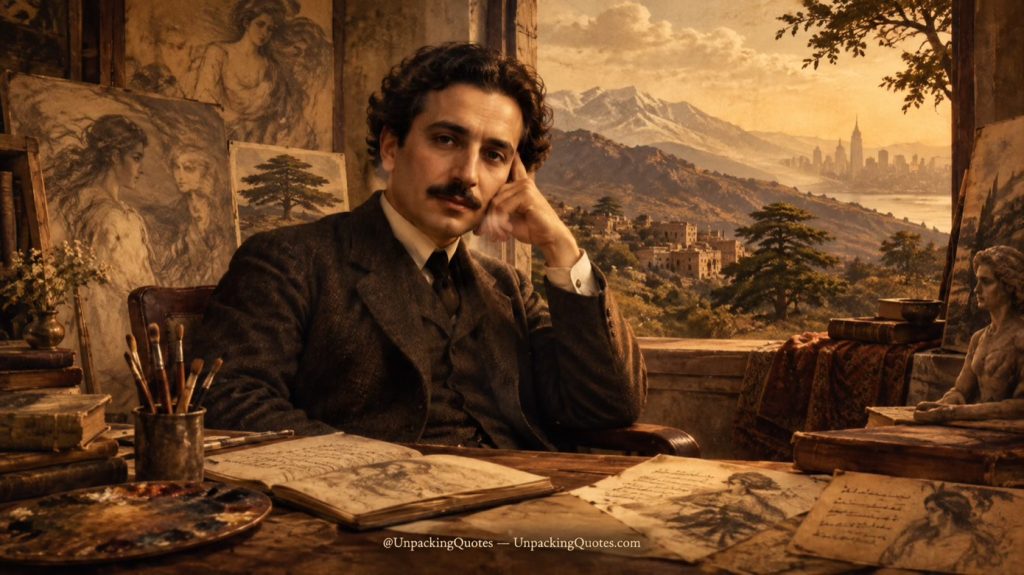
Kahlil Gibran (1883–1931), often rendered in English as Kahlil Gibran, was a Lebanese-born writer, poet, philosopher, and visual artist who spent much of his adult life in the United States. He wrote in both Arabic and English and became one of the important figures in the modernization of Arabic literature during the first half of the twentieth century.
Gibran was born in Bsharri, in present-day Lebanon, and emigrated to the United States with his mother and siblings as a child. He later returned to Lebanon for further education and studied in Beirut before spending time in Europe. His life therefore crossed several cultural worlds—Lebanese, Arab, European, and American—and that multicultural experience became an important element of his literary identity.
His best-known work, The Prophet, was published in 1923. The book consists of 26 prose-poetry chapters in which Almustafa, a prophet preparing to leave the city of Orphalese, responds to questions about fundamental aspects of human existence, including love, marriage, children, work, freedom, joy, sorrow, and death.
Gibran’s writing often combines spiritual reflection, philosophical ideas, poetic symbolism, and accessible language. This combination helped make The Prophet extraordinarily popular with general readers, even though literary critics were considerably more divided about the work.
3. Historical and Cultural Context
The Prophet appeared in 1923, a period of enormous cultural and social change. Gibran himself belonged to a generation shaped by migration, modernization, cultural encounters between East and West, and political upheaval in the Middle East. His writing consequently occupies an unusual space between Arabic literary traditions and Western literary culture.
Gibran was also an important figure in al-Rabitah al-Qalamiyyah, or the Pen-Bond, a literary group formed in New York in 1920 by Arab-American writers. The group sought to move Arabic literature away from what its members regarded as rigid traditional forms and toward greater literary freedom and individual expression. Gibran served as its president.
That cultural background helps illuminate the language of The Prophet. Its ideas are presented not as a conventional philosophical treatise but as poetic wisdom spoken by a prophetic figure. The book’s style has connections to Eastern spiritual and philosophical traditions as well as to the literary culture Gibran encountered in Europe and America.
The chapter “On Children” fits naturally into this larger framework. Gibran treats family relationships not merely as social arrangements but as questions about freedom, love, identity, and the human relationship to life itself.
4. Why the Quote Still Matters Today
The quotation remains relevant because the tension it describes has not disappeared: How do we guide children without attempting to control who they become?
Modern parents face this question in education, careers, relationships, religion, politics, personal values, and lifestyle. A parent may sincerely believe that a particular path will produce a happier or more successful life for a child, yet the child’s individuality may lead somewhere completely different.
Gibran’s message does not mean that parents should become passive or indifferent. Children require boundaries, protection, education, discipline, and emotional support. His point is more fundamental: guidance should not become ownership.
The quotation can also be understood beyond childhood. It applies to the moment when adult children begin making decisions that their parents would not have made themselves. At that point, love may require parents to replace control with trust.
There is also a broader human lesson here. We often try to possess what we love—our children, our partners, our friendships, even our accomplishments. Gibran reminds us that love can become deeper when it respects the independent existence of what it loves.
5. Summary
Gibran’s statement is ultimately about love without possession.
Children come through their parents, but they are not simply extensions of their parents. They arrive with their own temperaments, abilities, questions, dreams, and possibilities.
A parent can provide the soil, water, protection, and nourishment—but cannot dictate exactly how the tree will grow.
The wisdom of the passage is therefore not to love children less, but to love them in a way that leaves room for them to become themselves.
Explore Similar Quotes
Browse the Author Collection
Practicing the Wisdom of the Quote
1. Guide without scripting
Give your children principles, knowledge, and experience—but distinguish between saying “Here is what I have learned” and “This is what you must become.”
2. Listen for who they are
Sometimes parents listen primarily for what they want their children to say. Practice listening instead for the child’s actual interests, fears, talents, and aspirations.
3. Separate your dreams from theirs
Ask yourself:
“Is this something my child genuinely wants, or something I wanted for myself?”
That single question can reveal a great deal.
4. Allow appropriate failure
Protecting children from every mistake can prevent them from developing judgment. Where the consequences are safe enough to permit it, allow them to experience mistakes and learn from them.
5. Teach values, not scripts
Values such as honesty, responsibility, compassion, courage, and perseverance can provide direction without prescribing an entire life.
6. Respect the adult they become
Parenting changes over time. The relationship between a parent and a young child naturally involves authority; the relationship with an adult child increasingly requires mutual respect.
7. Practice love that releases
One of the hardest forms of parental love is knowing when to step back.
The goal is not to make a child permanently dependent on the parent. It is to help raise a person capable of standing independently while still knowing they are loved.
Poem Inspired by the Quote
What We Give Them
We give them names,
but not their destiny.
We give them hands to hold,
a doorway to return to,
stories from the roads
we have already traveled.
We teach them where the stones are,
warn them about the storms,
and hope they will remember
the lessons we learned too late.
But they arrive carrying
a language of their own—
dreams we did not dream,
questions we cannot answer,
a horizon we cannot see.
So let us give them roots,
but not chains.
Let us give them wisdom,
but not our unfinished lives.
Let us teach them how to stand,
then make room for them to walk.
For a child is not a possession
to keep beneath our roof.
A child is a life
passing through our hands—
briefly entrusted,
deeply loved,
and finally free
to become
what only life knows
how to make.