
Site logo
    • Home
    • Start Here
    • Quotes
      • Browse All the Quotes
      • Share Your Quote
    • Authors
    • About UnpackingQuotes.com
    Sign in
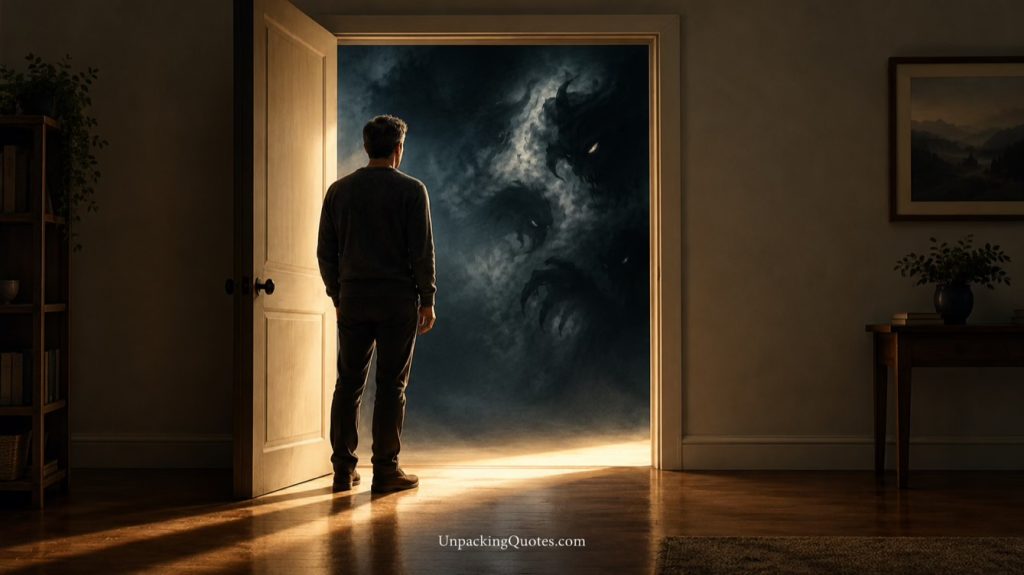
    A solitary figure standing before a dark doorway illuminated by a narrow beam of light, symbolizing the courage to confront hidden fears and unquestioned thoughts.

    “The scariest monsters aren't hiding under the bed. They're hiding inside the thoughts we never question.”

      • Unpacking the Quote
      • Practicing the Wisdom
      • Poetry & Lyrics
      • prev
      • next
      • Bookmark
      • Share
      • prev
      • next

      The Monsters Within: Question the Thoughts That Control You

      “The scariest monsters aren't hiding under the bed. They're hiding inside the thoughts we never question.”
      — Author Unknown

      1. Meaning of the Quote

      Some of the most frightening things in life are not external threats. They are the thoughts, assumptions, fears, and beliefs that quietly shape how we see ourselves, other people, and the world.

      The image of monsters hiding under the bed recalls a childhood fear: something frightening lurking in the darkness, waiting to emerge. But this saying turns that familiar image into a metaphor for something much closer and potentially more dangerous: the unexamined thoughts living inside our own minds.

      A thought can become a monster when we accept it without questioning its truth. The belief that we are not good enough, that failure makes us worthless, that people cannot be trusted, or that our circumstances will never change can gradually become an invisible prison. These ideas may feel like facts simply because we have repeated them to ourselves for so long.

      The most powerful part of this saying is the phrase “we never question.” It suggests that the danger does not necessarily lie in having negative thoughts. Everyone experiences fear, doubt, insecurity, and uncertainty. The real danger emerges when we stop examining those thoughts and allow them to govern our decisions.

      An unquestioned thought can become a belief. A belief can become a habit. And a habit of thinking can eventually become a way of life.

      The message is ultimately an invitation to intellectual honesty and self-awareness. We cannot challenge what we refuse to examine. Sometimes, the first step toward freedom is simply having the courage to ask ourselves: Is this thought actually true?

      2. About the Author

      Author: Unknown / Unattributed

      No verifiable author or original publication has been established for this exact wording. It is best treated as an unattributed contemporary saying rather than assigned to a famous philosopher or writer without evidence.

      Its central idea, however, has deep philosophical roots. Thinkers throughout history have explored the relationship between our thoughts, beliefs, perceptions, and freedom.

      For example, the Stoic philosopher Epictetus emphasized that our judgments about events often influence our emotional responses more than the events themselves. Socrates encouraged people to examine their beliefs rather than accept them unquestioningly. Centuries later, Carl Jung explored the hidden dimensions of the human psyche, including aspects of ourselves that we may resist acknowledging.

      Although none of these thinkers can be credited with this particular saying, their philosophical traditions help illuminate its message: understanding the mind requires the willingness to examine what lies beneath the surface.

      3. Historical Context and Culture

      The monster under the bed is a familiar image in childhood imagination. It represents the fear of the unknown, the darkness we cannot see into, and the possibility that something frightening may be hiding just beyond our awareness.

      Across cultures, monsters have often represented more than supernatural creatures. In mythology, literature, folklore, and religious storytelling, they have served as symbols of human fears, destructive impulses, moral weaknesses, and the unknown.

      As psychological thinking developed, the idea of the inner monster acquired another dimension. Rather than looking exclusively for danger outside ourselves, writers and philosophers increasingly explored the conflicts, fears, prejudices, and irrational beliefs within the human mind.

      In The Republic, Plato used the famous Allegory of the Cave to illustrate how people can mistake limited perceptions for reality. The lesson is not that every familiar belief is false, but that understanding requires questioning what we think we know.

      Similarly, Jung's exploration of the shadow encouraged a deeper examination of the parts of ourselves that remain unacknowledged or unintegrated.

      This saying brings these longstanding ideas into a contemporary, accessible metaphor. Its monster is not a creature from folklore but an unquestioned thought that may quietly influence an entire life.

      4. Relevance Today

      We live in an age of constant information, opinions, comparisons, and competing interpretations of reality. Yet having access to more information does not necessarily mean developing better judgment.

      People can become trapped by assumptions about their abilities, their relationships, their future, and even their own worth. Sometimes these assumptions originate in childhood experiences; sometimes they develop through disappointment, social expectations, repeated criticism, or the influence of the surrounding culture.

      Consider a person who believes they are incapable of succeeding. They may avoid opportunities, reject challenges, and interpret every setback as confirmation of their inadequacy. The original thought gradually becomes a self-fulfilling limitation.

      The same mechanism can operate in relationships. An unquestioned assumption that nobody can be trusted may prevent someone from experiencing genuine connection. A belief that changing direction means failure may keep someone in a situation that no longer serves them.

      Social media can make this problem even more complicated. Repeated exposure to unrealistic standards, polarized opinions, and distorted representations of other people's lives can reinforce beliefs that deserve closer examination.

      The answer is not to distrust every thought or replace negative thinking with artificial positivity. It is to develop intellectual independence: the ability to distinguish evidence from assumption, reality from interpretation, and a passing emotion from a lasting truth.

      The most important question may not be whether a thought is comfortable or uncomfortable, but whether it is accurate, reasonable, and worthy of influencing our lives.

      5. Summary

      The monsters we fear most are not always external. Sometimes they are the invisible beliefs and assumptions that influence our decisions without our awareness.

      This saying reminds us that thoughts should not automatically be treated as facts. Fear, insecurity, prejudice, and self-doubt become more powerful when we allow them to remain unexamined.

      The path to freedom begins with awareness and continues through honest questioning. We cannot control every thought that enters our minds, but we can learn to examine the thoughts we choose to believe.

      Sometimes the greatest act of courage is not fighting a monster, but discovering that the monster was a belief we never questioned.

      Explore Similar Quotes

      • Mind & Perspective
      • Human Nature
      • Wisdom & Life Lessons

      Discover More Quotes

      • Critical thinking
      • Beliefs
      • Self-awareness
      • Fear
      • perception
      • Independent thinking
      • Unexamined assumptions

      Practice & Application: Learn to Question Your Inner Monsters

      “The scariest monsters aren't hiding under the bed. They're hiding inside the thoughts we never question.”

      Understanding this saying is only the beginning. Its real value appears when we apply it to the way we think, make decisions, and respond to life.

      The following practices can help turn self-awareness into a daily habit.

      Practice 1: Identify the thought

      Pay attention to recurring thoughts that create fear, insecurity, anger, or unnecessary limitations.

      When one appears, write it down. For example:

      I am not good enough.
      People always disappoint me.
      It is too late to start again.
      I will never succeed.
      Nothing will ever change.

      Do not immediately judge yourself for having these thoughts. The first objective is simply to recognize them.

      Practice 2: Challenge the assumption

      Ask yourself three questions:

      What evidence supports this thought?
      What evidence contradicts it?
      Am I confusing an experience from my past with an unavoidable truth about my future?

      A thought may feel convincing without being accurate. Learning to distinguish the two is an essential part of emotional and intellectual maturity.

      Practice 3: Consider another perspective

      Try looking at the same situation from a different point of view.

      Instead of thinking, "I failed, so I am incapable," consider, "I experienced a setback, and I can learn from it."

      Instead of thinking, "Nobody understands me," consider, "Perhaps I have not yet found the right way to communicate what I feel."

      Changing perspective does not mean denying reality. It means allowing yourself to consider possibilities that fear may have concealed.

      Practice 4: Replace limiting beliefs with constructive ones

      Once you identify an inaccurate or exaggerated belief, replace it with something more balanced and realistic.

      For example:

      "I cannot do this" becomes "I have not learned how to do this yet."
      "I am too old to change" becomes "I can still grow, learn, and make meaningful changes."
      "One mistake defines me" becomes "One mistake is an experience, not my identity."

      The objective is not blind optimism. It is more accurate thinking.

      Practice 5: Take one action that contradicts the fear

      Thoughts become especially powerful when they determine what we do or avoid doing.

      If you believe you cannot learn something new, take the first small step toward learning it. If you assume a difficult conversation will end badly, prepare for it and approach it thoughtfully.

      Action provides new experiences, and new experiences can challenge old beliefs.

      A daily reflection

      At the end of each day, take a few minutes to consider:

      What thought influenced my decisions today?
      Did I question it, or simply accept it?
      Was it based on evidence, fear, habit, or assumption?
      What could I think or do differently tomorrow?

      Over time, this simple exercise can help you become less controlled by automatic thinking and more deliberate in your responses.

      The essential lesson: Do not believe everything your mind tells you. Listen to your thoughts, examine them, and decide which ones deserve a place in your life.

      The Monsters Within

      An original poem inspired by “The scariest monsters aren't hiding under the bed. They're hiding inside the thoughts we never question.”

      There are no footsteps in the hall,
      No shadows climbing up the wall.
      No claws that scratch, no eyes that gleam,
      Yet something stirs inside the dream.

      It speaks in whispers, soft and low,
      Of all the things we fear to know.
      It tells us we are not enough,
      That life is cruel, the road is rough.

      It wears the face of yesterday,
      And steals tomorrow's light away.
      It builds its walls with doubt and fear,
      Until the truth becomes unclear.

      But monsters weaken in the light,
      When questioned by a mind awake.
      For every fear we dare to face
      Can lose its power and leave its place.

      So lift the veil, examine why,
      Let reason be the searching eye.
      The greatest chains are often wrought
      From all the things we never thought to question.

      And when those chains begin to fall,
      We find no monster there at all.
      Just thoughts we carried far too long,
      Mistaken for the truth, made strong.

      You May Also Be Interested In

      “He who knows others is wise; he who knows himself is enlightened.” — Lao Tzu

      “You Have Power Over Your Mind” — Marcus Aurelius

      What Does Not Kill Me Makes Me Stronger — Nietzsche's Meaning

      “Not All Those Who Wander Are Lost” — Tolkien

      “We are all in the gutter, but some of us are looking at the stars.” — Oscar Wilde

      “The mass of men lead lives of quiet desperation.” — Henry David Thoreau

      “Happiness Depends Upon Ourselves.” — Aristotle

      Life can only be understood backwards; but it must be lived forwards — Søren Kierkegaard

      He who learns but does not think, is lost. He who thinks but does not learn is in great danger — Confucius

      The journey of a thousand miles begins with a single step — Lao Tzu

      If it is not right, do not do it; if it is not true, do not say it — Marcus Aurelius

      Waste no more time arguing about what a good man should be. Be one - Marcus Aurelius

      When Anyone Provokes You, Be Assured That It Is Your Own Opinion Which Provokes You - Epictetus

      It Is Difficulties That Show What Men Are - Epictetus On Character

      Everything Should Be Made as Simple as Possible, but Not Simpler — Einstein

      Men are disturbed not by things, but by the views which they take of things - Epictetus

      Some Things Are in Our Control and Others Not - The Stoic Wisdom of Epictetus

      We Cannot Choose Our Circumstances, But We Can Choose How We Respond — Epictetus

      “The highest form of peace is having no desire to be seen, validated or understood by anyone.” — Epictetus

      “Your joy is your sorrow unmasked. And the selfsame well from which your laughter rises was oftentimes filled with your tears.”

      Your Children Are Not Your Children — Khalil Gibran

      The beginning is the most important part of the work - Plato

      The unexamined life is not worth living — Socrates

      Imagination Is More Important Than Knowledge - Albert Einstein

      The Only True Wisdom Is in Knowing You Know Nothing

      Luck is what happens when preparation meets opportunity

      The Happiness of Your Life Depends Upon the Quality of Your Thoughts

      Whoever fights monsters should see to it that in the process he does not become a monster

      He Who Is Not Satisfied With a Little Is Satisfied With Nothing — Epicurus

      Fear of the Truth: Why We Prefer the Safety of the Shadows

      “He Who Has a Why to Live…” — Nietzsche on Purpose and Meaning

      Do Not Pray for Easy Lives: Pray for the Strength to Meet Your Tasks

      The Wisdom of Changing Yourself Before Changing the World | Rumi

      We Are What We Repeatedly Do: Excellence as a Habit — Aristotle

      Happiness Is Not by Chance, but by Choice: The Power of Choosing How We Live

      The Power of Questions: What Socrates Really Meant by “I Cannot Teach Anybody Anything”

      You can lead a horse to water, but you can’t make him drink — English proverb

      What Is Culture? Understanding “Culture Is What Remains When One Has Forgotten Everything”

      To Keep Your Balance, You Must Keep Moving.” — Albert Einstein

      Not All Storms Come to Disrupt Your Life: Meaning, Lessons & How to Find the Path Forward

      “We Suffer More Often in Imagination Than in Reality” — Seneca: Meaning, Stoic Wisdom & How to Stop Overthinking

      Sorrow and Joy | Kahlil Gibran, The Prophet (1923)

      “There is only one way to happiness and that is to stop worrying about things which are beyond the power of our will.” — Epictetus

      Whenever you Find Yourself on the Side of the Majority—Mark Twain

      Men Worry more about what They Can’t See—Julius Caesar

      to Get Over the Past You First Have to Accept the Past Is Over

      The Man Who Moves a Mountain Begins by Carrying Away Small Stones - Confucius

      All quote explanations, interpretations, practices, applications, lyrics, poems, and original creative works published on UnpackingQuotes.com are protected by copyright.

      The lyrics and poems inspired by the ideas, themes, and wisdom of the quotes are original creative works of UnpackingQuotes.com unless otherwise stated.

      © Unpacking Quotes 2026 - All rights reserved
      Unpacking the Quote. Practicing the Wisdom. Creating the Lyrics.

        • Facebook
        • X
        • WhatsApp
        • Viber
        • Telegram
        • Pinterest
        • LinkedIn
        • Tumblr
        • Reddit
        • VKontakte
        • Mail
        • Copy link
        • Share via...
        • Threads
        • Bluesky