
Site logo
    • Explore Inspiring Quotes
    • About UnpackingQuotes.com
    Sign in
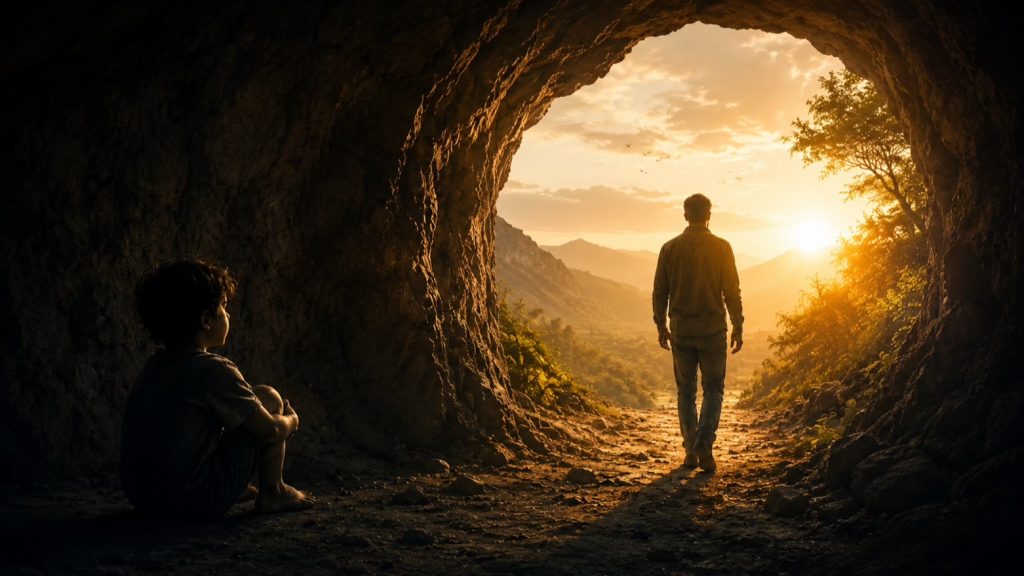
    “We can easily forgive a child who is afraid of the dark; the real tragedy of life is when men are afraid of the light.”

    Fear of the Truth: Why We Prefer the Safety of the Shadows

      • Unpacking the Quote
      • Practicing the Wisdom
      • Poetry & Lyrics
      • prev
      • next
      • Bookmark
      • Share
      • prev
      • next

      “We can easily forgive a child who is afraid of the dark; the real tragedy of life is when men are afraid of the light.”
      — Often attributed to Plato; attribution unverified

      1. Meaning of the Quote

      A child who is afraid of the dark is afraid of what cannot be seen.

      The darkness represents the unknown. A child may imagine dangers that are not there because the absence of light makes it difficult to distinguish reality from imagination. Such fear is understandable. The child has not yet developed the experience, knowledge, or perspective needed to understand what is actually in the darkness.

      But the quotation draws a very different picture when it speaks of an adult who is “afraid of the light.”

      Light represents what can be seen clearly: truth, knowledge, understanding, awareness and reality.

      The tragedy, therefore, is not ignorance itself. None of us begins life knowing everything. Nor is fear itself something shameful. Fear is a natural human response to uncertainty, vulnerability and perceived danger.

      The deeper problem is being afraid of what would illuminate the truth.

      An adult may fear the light because the light reveals things that are difficult to accept, such as the fact that we were wrong, that a relationship is unhealthy, that a dream no longer reflects who we are, a personal weakness we have spent years avoiding, or an uncomfortable truth about the world.

      And sometimes it may reveal something even more demanding:

      that now that we know the truth, we must do something about it.

      This is what makes the metaphor so powerful. Darkness can conceal us and light exposes us. And while ignorance can sometimes feel comfortable, genuine understanding often demands courage.

      The quotation therefore asks us to distinguish between fear of the unknown and fear of knowing. The first is human. The second can become a prison.

      2. About the Author — Plato?

      Plato (c. 428/427–348/347 BCE) was one of the foundational philosophers of the Western tradition.

      A student of Socrates and the teacher of Aristotle, Plato founded the Academy in Athens and wrote philosophical dialogues exploring subjects including justice, knowledge, virtue, politics, education, love and the nature of reality.

      Among his best-known works is The Republic, which contains the famous Allegory of the Cave.

      The connection between Plato and this quotation is therefore understandable. Plato repeatedly explored the movement from ignorance toward knowledge, from appearance toward reality, and from intellectual confusion toward understanding.

      But there is a crucial distinction between philosophical resemblance and authorship.

      Did Plato actually say this?

      There is no known passage in Plato’s surviving writings containing this quotation. Quote researchers have specifically identified it as a quotation commonly attributed to Plato but absent from his works. 

      That makes the traditional attribution problematic.

      And there is an additional complication.

      The wording is associated with Robin Sharma’s 1997 book The Monk Who Sold His Ferrari. A scholarly study of fear published in 2019 states that the familiar quotation is not Platonic but identifies Sharma’s book as the source of the phrase. 

      However, Sharma’s text itself does not simply claim authorship. In the book, the character Julian Mantle says he had encountered a saying from the ancient thinker Plato and quotes a version referring to adults being afraid of the light. 

      This distinction matters enormously.

      The responsible attribution

      We therefore cannot responsibly say:

      Plato wrote this.

      Nor can we confidently say:

      Robin Sharma wrote this.

      What we can say is:

      The quotation is widely attributed to Plato, but it is not found in Plato’s surviving works. A closely corresponding version appears in Robin Sharma’s 1997 The Monk Who Sold His Ferrari, where Sharma presents it as a saying attributed to Plato. The ultimate original source remains uncertain.

      3. Historical and Cultural Context

      The quotation’s imagery becomes much more interesting when viewed against the history of the light-versus-darkness metaphor.

      Long before this modern wording appeared, philosophers used light and darkness to represent knowledge and ignorance.

      Plato’s Allegory of the Cave

      The strongest reason the quotation became attached to Plato is almost certainly its resemblance to the Allegory of the Cave in The Republic.

      Plato describes human beings confined inside a cave, seeing only shadows projected onto a wall. One person is eventually freed and forced to turn toward the light. The transition is painful because the person is accustomed to the darkness.

      Eventually, the person emerges from the cave and encounters the world outside—and ultimately the sun itself.

      The allegory represents a movement from appearance toward reality and ignorance toward knowledge. That is remarkably close to the conceptual structure of our quotation. But we must not confuse the two. Plato’s Cave is authentic Plato. The quotation about the child and the light is not. The similarity may help explain why later generations attached the saying to Plato.

      An even older parallel

      There is also an important ancient Roman precedent. The Roman philosopher Seneca, discussing fear, quoted the earlier Roman poet and philosopher Lucretius, who expressed the idea that human beings can be afraid in the light just as children are afraid in the dark. Quote researchers identify this as an ancient philosophical parallel to the modern saying. 

      This is significant because it shows that the underlying idea is ancient, even though the familiar English sentence is not demonstrably ancient.

      The modern trail

      The modern quotation has circulated widely under Plato’s name, often without a citation to any dialogue or passage. Interestingly, a 1952 newspaper report already contained a very similar formulation: a speaker was quoted saying that one could forgive a child who feared the dark but not a man who feared the light. 

      That means the wording has a more complicated modern history than the simple Internet attribution “—Plato” suggests. The evidence currently supports a cautious conclusion:

      The thought is ancient. The exact quotation is modern. Its ultimate origin remains uncertain.

      That distinction is precisely the kind of distinction a serious quotation site should preserve.

      4. Relevance Today

      The quotation is arguably even more relevant today because we live in an age of extraordinary access to information.

      We have more opportunities than ever to know. Yet having access to information is not the same as being willing to face the truth. People can still be afraid of the light, and avoid information that challenges our political, cultural or personal beliefs.

      We often reject criticism because it threatens our self-image, ignore evidence that would necessitate change, remain in unhealthy relationships to avoid making painful decisions, and steer clear of honestly examining our own behavior due to the discomfort that self-knowledge can bring.

      In all these situations, the darkness is not necessarily a lack of information. Sometimes the light is already there, and we simply do not want to look. And this may be the deepest contemporary interpretation of the quotation:

      The greatest obstacle to truth is not always ignorance. Sometimes it is our emotional investment in remaining ignorant.

      That applies to individuals, institutions and societies. A person who is willing to say “I may be wrong” has already opened the door to the light. A person who insists “I cannot possibly be wrong” may have closed it.

      5. Summary

      The quotation contrasts two fears.

      The child’s fear of darkness is understandable because darkness represents the unknown. The adult’s fear of light is more troubling because light represents knowledge, truth and awareness.

      The quotation does not condemn fear itself. It challenges our willingness to remain in ignorance because truth is uncomfortable. Its central message can be expressed simply:

      It is natural to fear what we cannot see. It is tragic to fear what would allow us to see clearly.

      The wisdom of the quotation is therefore not simply “do not be afraid.”

      It is:

      Have the courage to see.

      See reality, yourself, and what you would rather not see. And once you see it, have the courage to act.

      Explore Similar Quotes

      • Courage & Resilience
      • Truth & Authenticity
      • Mind & Perspective

      Discover More Quotes

      • Fear
      • Courage
      • Trust
      • Awareness
      • Self-awareness
      • Human nature

      Browse the Author Collection

      • Plato

      The quotation becomes most valuable when it moves from philosophy into behavior.

      1. Ask yourself what you are avoiding

      What truth have you been reluctant to examine?

      Don’t begin by judging yourself. Begin by asking: “What am I afraid I might discover?”

      That question can illuminate the source of the fear.

      2. Learn to tolerate uncomfortable truth

      Truth does not become false because it makes us uncomfortable.

      When criticism is valid, listen.

      When evidence contradicts your assumption, reconsider.

      When experience reveals that something is not working, acknowledge it.

      Intellectual maturity means being able to change your mind without experiencing it as a defeat.

      3. Separate truth from ego

      One of the greatest barriers to the light is the desire to be right.

      Sometimes we defend an opinion because changing it would feel like admitting failure. But being wrong about something is not a failure. However, refusing to correct an error after discovering it is.

      4. Practice honest self-examination

      Set aside a few minutes periodically and ask:

        • What am I pretending not to know?
        • Where am I making excuses?
        • What criticism about me might contain some truth?
        • What decision am I postponing?
        • What would I do differently if I were completely honest with myself?

      These questions are uncomfortable precisely because they turn the light inward.

      5. Do not confuse comfort with truth

      The easiest explanation is not necessarily the correct one.

      The most comfortable relationship is not necessarily the healthiest.

      The belief that makes us feel best is not necessarily the belief closest to reality.

      Sometimes growth begins when we willingly exchange comfortable certainty for uncomfortable understanding.

      6. Turn knowledge into action

      Seeing the light is only the beginning.

      If you recognize the problem but refuse to act, awareness becomes another form of avoidance.

      The ultimate purpose of wisdom is transformation.

      See clearly. Accept honestly. Act courageously

      A Poem Inspired by the Quote

      Afraid of the Light

      There was a child who feared the night,
      The shapes that moved beyond his sight,
      The silent room, the hidden door,
      The things he could not see before.

      We understood his trembling hands,
      For darkness hides what no one understands.
      We brought a lamp, we stayed nearby,
      Until the shadows learned to die.

      But years go by, and children grow,
      And different kinds of darkness show.
      Not underneath the bed at night,
      But in the places touched by light.

      A truth arrives—we turn away.
      A mirror speaks—we look elsewhere.
      A question asks what we have done,
      And suddenly we miss the sun.

      For light can show the road ahead,
      But it can also show the road we fled.
      It tells us what we must repair,
      And makes us answer what is there.

      So let the light fall where it may.
      Let it reveal the hidden day.

      For darkness may protect the eye,
      But truth is where we learn to live, not hide.

      And if the light should hurt at first,
      If seeing clearly feels like thirst,
      Remember this when fear takes hold:

      The truth may wound,
      but lies grow old.

      The child fears darkness because he cannot see.

      The tragedy is when we grow old
      and become afraid to see.

      You May Also Be Interested In

      Luck is what happens when preparation meets opportunity

      The Happiness of Your Life Depends Upon the Quality of Your Thoughts

      Whoever fights monsters should see to it that in the process he does not become a monster

      The Philosophy of Enough: Unpacking Epicurus on Gratitude and Contentment

      “He Who Has a Why to Live…” — Nietzsche on Purpose and Meaning

      Do Not Pray for Easy Lives: Pray for the Strength to Meet Your Tasks

      The Wisdom of Changing Yourself Before Changing the World | Rumi

      We Are What We Repeatedly Do: Excellence as a Habit | Aristotle

      Happiness Is Not by Chance, but by Choice: The Power of Choosing How We Live

      The Power of Questions: What Socrates Really Meant by “I Cannot Teach Anybody Anything”

      You can lead a horse to water, but you can’t make him drink — English proverb

      What Is Culture? Understanding “Culture Is What Remains When One Has Forgotten Everything”

      To Keep Your Balance, You Must Keep Moving.” — Albert Einstein

      Not All Storms Come to Disrupt Your Life: Meaning, Lessons & How to Find the Path Forward

      “We Suffer More Often in Imagination Than in Reality” — Seneca: Meaning, Stoic Wisdom & How to Stop Overthinking

      Sorrow and Joy | Kahlil Gibran, The Prophet (1923)

      There is Only One Way to Happiness—Epictetus

      Whenever you Find Yourself on the Side of the Majority—Mark Twain

      All quote explanations, interpretations, practices, applications, lyrics, poems, and original creative works published on UnpackingQuotes.com are protected by copyright.

      The lyrics and poems inspired by the ideas, themes, and wisdom of the quotes are original creative works of UnpackingQuotes.com unless otherwise stated.

      © Unpacking Quotes 2026 - All rights reserved
      Unpacking the Quote. Practicing the Wisdom. Creating the Lyrics.

        • Facebook
        • X
        • WhatsApp
        • Viber
        • Telegram
        • Pinterest
        • LinkedIn
        • Tumblr
        • Reddit
        • VKontakte
        • Mail
        • Copy link
        • Share via...
        • Threads
        • Bluesky