

“Not All Those Who Wander Are Lost” — Tolkien Quote Meaning
“Not all those who wander are lost.”
— J.R.R. Tolkien
1. Meaning of the Quote
“Not all those who wander are lost” challenges the assumption that a person must always follow a clearly defined path to live a meaningful life. We often associate direction with certainty, progress with visible achievements, and success with following a predictable route. When someone steps away from familiar expectations, changes direction, or explores an unconventional way of living, others may interpret that choice as confusion or failure. Tolkien invites us to question that judgment.
Wandering is not necessarily the same as being lost. A person may explore unfamiliar places, reconsider long-held beliefs, change careers, or enter a period of uncertainty without having abandoned their deeper purpose. Sometimes the journey itself is necessary to discover what matters, develop wisdom, or recognize a direction that could never have been understood in advance.
The quote also distinguishes external appearances from inner reality. Someone who seems uncertain to the world may possess a strong sense of personal values, even if their destination is not immediately visible. Conversely, a person who appears successful and settled may be living according to expectations that have little connection to their authentic aspirations.
There is, however, an important distinction between purposeful exploration and aimlessness. Tolkien’s words do not suggest that every detour is beneficial or that direction is unnecessary. Rather, they remind us that a meaningful life does not always proceed in a straight line. Exploration can involve deliberate choices, reflection, and the willingness to learn from experiences whose value becomes clear only later.
The quote’s original literary context deepens this meaning. In The Lord of the Rings, the line describes Aragorn, a man who travels through the wilderness as a ranger while concealing his royal heritage. His outward appearance does not reveal his identity, and his wandering does not mean he has abandoned his responsibility. His journey has a purpose even when others cannot see it.
At a personal level, the wisdom is both reassuring and demanding. It reassures us that uncertainty does not automatically mean failure, but it also encourages us to examine our intentions. Are we exploring because we want to learn and grow, or are we avoiding a responsibility we know we must face? The difference lies not simply in where we are going, but in how consciously we choose to travel.
Ultimately, the quote invites us to resist judging a life solely by its outward direction. Some journeys lead us toward a destination; others help us discover who we are. Both can be valuable when approached with awareness, courage, and a willingness to learn.
2. About the Author — J.R.R. Tolkien
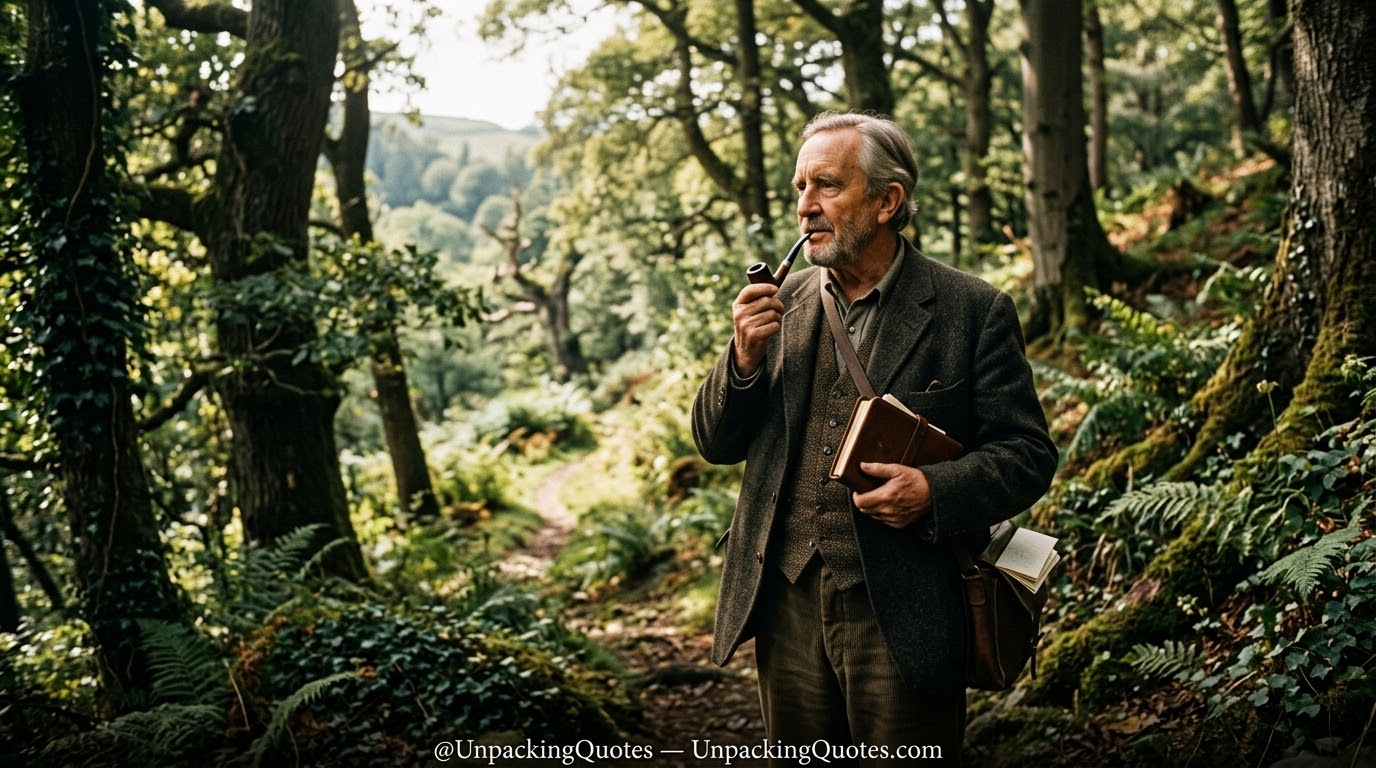
John Ronald Reuel Tolkien (1892–1973), English writer, philologist, university professor, and creator of Middle-earth
J.R.R. Tolkien was an English scholar of language and literature whose academic knowledge of mythology, medieval literature, and ancient languages shaped some of the most influential fantasy works of the twentieth century.
Born on January 3, 1892, in Bloemfontein, in what is now South Africa, Tolkien spent much of his life in England. He became a professor at the University of Oxford, specializing in Anglo-Saxon language and literature, and developed a lifelong interest in the origins of words, ancient stories, and the cultural traditions that shape human understanding.
His best-known works include The Hobbit (1937) and The Lord of the Rings, published in three volumes between 1954 and 1955. He created Middle-earth as a richly developed fictional world with its own languages, histories, peoples, legends, and moral struggles.
Tolkien’s storytelling frequently explores courage, friendship, humility, temptation, sacrifice, and the difference between outward power and inner worth. His heroes are not always the strongest or most celebrated characters. Often, the moral significance of a person emerges through perseverance, loyalty, and decisions made when the outcome remains uncertain.
Tolkien’s academic background helps explain why his writing often carries meaning beyond the immediate action of a story. He drew on older literary traditions while creating original characters and narratives that speak to enduring questions about identity, duty, mortality, and the human relationship with the unknown.
He died on September 2, 1973, in Bournemouth, England. His work continues to influence literature, film, popular culture, and the way readers think about journeys, personal growth, and the struggle to do what is right.
3. Historical Context and Culture
The quote belongs to the literary world of The Lord of the Rings, a work Tolkien developed over many years and published in the middle of the twentieth century. Although the story is set in an imagined world, it draws extensively on European mythology, medieval literature, heroic legends, and the traditions of epic storytelling.
The line appears in the poem commonly called the Riddle of Strider, also associated with its opening words, “All that is gold does not glitter.” In the story, Bilbo Baggins writes the poem about Aragorn. Gandalf includes it in a letter intended to help Frodo recognize the mysterious ranger known as Strider. The poem reveals that appearances can conceal a deeper identity and a destiny not immediately apparent to others.
This context matters because the line is more specific than a general endorsement of travel or spontaneity. Aragorn is not simply a wanderer searching for himself. He has a hidden heritage, a sense of responsibility, and a role in the struggle against evil. His years of travel and service are connected to a larger purpose, even though the people he encounters may not recognize his significance.
Tolkien’s treatment of Aragorn also reflects a recurring theme in traditional heroic literature: the rightful leader may initially appear ordinary, obscure, or unworthy of recognition. True worth is not always accompanied by wealth, prestige, or visible authority. The opening line of the same poem reinforces this idea by challenging the assumption that gold must glitter to be valuable.
The poem also introduces the theme of renewal. Its later lines refer to fire awakened from ashes, light emerging from shadows, a broken blade being reforged, and a king returning to his rightful place. These images connect Aragorn’s wandering to endurance, recovery, and the restoration of something that once seemed lost.
Read in its original context, the quote is therefore not simply about getting lost and enjoying the experience. It is about recognizing that a person’s apparent circumstances may not reveal their character, potential, or ultimate direction. Tolkien uses a fictional journey to explore a timeless human problem: how easily we mistake an unfamiliar path for a purposeless one.
4. Relevance Today
In contemporary life, the pressure to have everything figured out can make periods of uncertainty feel like personal failures. We are encouraged to set goals, measure progress, build careers, and demonstrate success. Social media intensifies this pressure by presenting other people’s lives as if they were coherent, purposeful journeys with clearly defined destinations.
Tolkien’s quote offers a valuable counterpoint: you do not have to know every step of your journey to move forward meaningfully.
1. Career changes and new beginnings
Leaving a familiar profession, returning to education, starting a business, or exploring a different vocation can appear risky or directionless. Yet these changes may reflect a growing understanding of one’s strengths, interests, or values. A temporary departure from the expected path can become the beginning of a more meaningful one.
2. Personal growth and self-discovery
People often discover who they are through experiences that challenge their assumptions. Travel, new friendships, unfamiliar responsibilities, and periods of solitude can reveal priorities that routine life leaves unexplored. The journey may not provide immediate answers, but it can teach us to ask better questions.
3. The courage to be different
Not everyone wants the same life. Some people value stability, while others seek exploration, creativity, independence, or intellectual discovery. Tolkien’s words remind us not to confuse a different set of priorities with an absence of purpose. A meaningful life does not have to resemble someone else’s definition of success.
4. Resilience during uncertain periods
Loss, retirement, relationship changes, and unexpected setbacks can disrupt even carefully designed plans. During such times, the next destination may be unclear. The quote offers reassurance that a disrupted route does not necessarily mean a diminished life. Sometimes rebuilding begins with accepting uncertainty rather than rushing to eliminate it.
5. The importance of purposeful exploration
The quote should not become an excuse for avoiding decisions indefinitely. Wandering can enrich life, but reflection and responsibility give exploration direction. We can remain open to new possibilities while still honoring our commitments, evaluating our choices, and taking practical steps toward what matters.
In a world that often rewards speed and certainty, Tolkien’s insight encourages patience. We can allow our understanding to develop, respect paths that look unfamiliar, and recognize that some forms of progress are invisible until we look back.
5. Summary
“Not all those who wander are lost” reminds us that an unconventional journey is not necessarily a purposeless one. People can grow, learn, and move toward meaningful goals without following a straight or predictable path.
Tolkien’s original context adds an essential dimension: Aragorn’s outward appearance conceals his identity and responsibility. The quote is therefore not merely an invitation to explore, but also a reminder that genuine worth and purpose are not always immediately visible.
Its enduring wisdom lies in the balance between openness and intention. We should not mistake uncertainty for failure, nor assume that every detour is progress. Instead, we can approach life’s unknowns with curiosity, courage, reflection, and a clear understanding of the values that guide us.
The journey may be unfamiliar. The destination may remain uncertain. What matters is that we continue to learn, choose consciously, and remain faithful to what gives our lives meaning.
Explore Similar Quotes
Browse the Author Collection
Practicing the Wisdom: How to Wander Without Losing Your Way
The practical lesson of Tolkien’s quote is not to abandon direction. It is to develop the confidence to explore while remaining connected to your values. You can be open to unexpected opportunities without surrendering responsibility for the life you are building.
Here are six ways to put this wisdom into practice.
1. Define your values before defining your destination
Goals tell you where you want to go; values help you decide how you want to live. A specific career, location, or achievement may change, but values such as integrity, curiosity, freedom, family, or service can remain meaningful throughout those changes.
Practice: Write down your five most important values. When considering a new opportunity, ask whether it supports those values, challenges them constructively, or pulls you away from them.
2. Give yourself permission to explore
Not every worthwhile experience must produce an immediate result. Reading outside your field, learning a language, visiting an unfamiliar place, or developing a new skill can expand your understanding without a predetermined payoff.
Practice: Choose one activity this week simply because it interests you. Give it your attention without demanding that it become productive, profitable, or impressive to others.
3. Distinguish uncertainty from avoidance
There is a difference between exploring possibilities and postponing a difficult decision. Exploration helps you discover what matters; avoidance keeps you from confronting what you already know needs attention.
Practice: When you feel uncertain, ask yourself two questions: “What do I still need to learn?” and “What decision am I reluctant to make?” Answering both honestly can help you identify your next step.
4. Measure progress by learning, not appearances
Some of the most valuable periods of life produce little external recognition. Developing patience, recovering from disappointment, revising an old belief, or becoming more aware of your limitations may not look like conventional success, but each can represent genuine growth.
Practice: At the end of each week, record one thing you learned, one assumption you reconsidered, and one action that brought you closer to the person you want to become.
5. Take the next step without demanding the entire map
Waiting for complete certainty can become a barrier to action. Many important decisions involve incomplete information. You can reduce unnecessary risk by taking small, reversible steps that help you learn more before making a larger commitment.
Practice: Identify one area in which you feel stuck. Choose a concrete action you can complete within the next seven days: make a phone call, research a course, have an honest conversation, or test an idea on a small scale.
6. Review your direction without judging your detours
A meaningful life involves adjustment. Some paths that once seemed right will stop serving you; others will become valuable only after experience changes your perspective.
Practice: Once a month, ask yourself:
- What currently gives my life meaning?
- What have I discovered about myself recently?
- Which commitments remain important?
- What am I continuing out of habit or fear?
- What is one change that would help me live more deliberately?
Use your answers to make thoughtful adjustments rather than treating every change of direction as evidence that you have failed.
A seven-day reflection challenge
Your reflection checklist
Day 1: Write down five personal values that matter most to you.
Day 2: Explore an idea, subject, or place you know little about.
Day 3: Identify one uncertainty you can learn more about.
Day 4: Take one small step toward a goal you have postponed.
Day 5: Notice one person whose path differs from your own without judging it.
Day 6: Write down a past detour that taught you something valuable.
Day 7: Review the week and choose one intentional next step.
The deeper practice is to remain both curious and responsible. You do not need to predict every turn in the road. You do need to pay attention to the choices you make, the lessons you encounter, and the values that give your journey direction.
Poetry & Lyrics Inspired by the Quote
“Not all those who wander are lost.”
— J.R.R. Tolkien
An original poem inspired by Tolkien’s idea of purposeful wandering. This poem is an independent creative work, not a poem by Tolkien.
The Unmapped Road
I left the road that others knew,
Where every mile had been defined,
And followed hills beneath the blue,
With questions walking close behind.
No distant bell proclaimed my name,
No sign revealed what lay ahead;
The changing sky, the wind, the rain
Became the words the silence said.
I learned that paths may twist and turn,
That roots grow deep where eyes cannot,
That some of life’s most truths we learn
In places we had first forgot.
The years may change the dreams we keep,
The stars may hide behind the cloud;
Yet seeds of purpose lie asleep
Until we dare to leave the crowd.
So let me walk with open eyes,
With steady heart and willing feet;
For wisdom wears no grand disguise,
And truth is not where roads all meet.
If I must pause, then let me rest;
If I must turn, then let me see
That journeys are not always tests,
But ways of learning how to be.
And when at last I look behind,
At all the roads I could not plan,
May I discover, in the winding,
I grew into the life I am.