
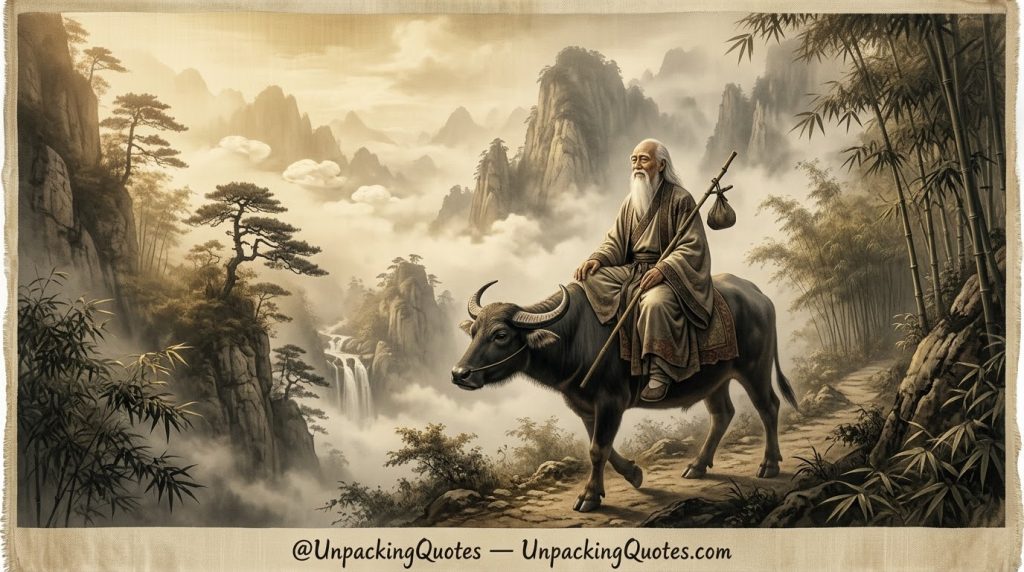
Lao Tzu Biography & Life Summary
"A journey of a thousand miles begins with a single step."
— Attributed to Lao Tzu
Overview & Quick Summary
Lao Tzu (literally "Old Master") was an ancient Chinese philosopher, scholar, and legendary founder of Taoism (Daoism). A central figure in Eastern thought, his classic text—the Tao Te Ching—explores the nature of the Tao (the fundamental, living Way of the universe) and offers timeless principles on harmony, simplicity, balance, and quiet leadership. His teachings serve as a profound alternative and complement to Confucian social order, focusing instead on alignment with natural law.
Key Life Events & Context
According to ancient Chinese historical accounts (notably Sima Qian’s Records of the Grand Historian), Lao Tzu served as the keeper of the royal archives for the Zhou Dynasty court in Luoyang. His position gave him vast access to ancient texts, earning him a reputation for deep wisdom—so much so that a young Confucius is said to have visited him to seek advice on ritual and ethics. Disillusioned by the decaying moral order of the Zhou court, Lao Tzu chose to depart China for the western frontier on a water buffalo. Recognized by a border gatekeeper named Yin Xi, Lao Tzu was asked to record his wisdom before leaving civilization forever, resulting in the 81 short chapters of the Tao Te Ching.
Core Philosophy & Major Themes
- The Tao (The Way): The nameless, ultimate force that underlies, flows through, and sustains all existence. Living wisely means aligning with this natural order rather than resisting or forcing it.
- Wu Wei (Effortless Action): Acting without artificial force or strain. Wu Wei does not mean laziness or inaction, but rather working in intuitive flow with natural circumstances—like water gently reshaping solid rock over time.
- Yin and Yang & Balance: All things contain inherent dualities (light/dark, hard/soft, yield/conquer). Lao Tzu emphasized the power of yielding, humility, and softness over rigid aggression.
- Quiet Leadership: The highest form of leadership is subtle and unobtrusive. "When the best leader's work is done, the people say, 'We did it ourselves.'"
Why His Wisdom Still Matters Today
In a hyper-stimulated, fast-paced modern world driven by constant achievement and control, Lao Tzu offers a stabilizing antidote. His lessons on simplicity, humility, letting go of obsessive control, and moving in harmony with nature provide practical strategies for reducing stress, cultivating inner calm, and leading with authentic grace.
NATIONALITY: Chinese.
BIRTH-DEATH-DATE: c. 6th Century BC – c. 5th Century BC (Traditional Dates).
ERA PERIOD: Classical Antiquity, Ancient China.
MAIN DISCIPLINE: Ethics, Metaphysics, Political Philosophy, Taoism (Daoism).
NOTABLE WORKS: Tao Te Ching (Dao De Jing)
BIRTH-DEATH-DATE: c. 6th Century BC – c. 5th Century BC (Traditional Dates).
ERA PERIOD: Classical Antiquity, Ancient China.
MAIN DISCIPLINE: Ethics, Metaphysics, Political Philosophy, Taoism (Daoism).
NOTABLE WORKS: Tao Te Ching (Dao De Jing)
Explore This Author’s Quotes
Click on any quote below to explore its Unpacking — discover its meaning, context, and relevance today.