

How to Start Over: Why Every Big Journey Begins With One Small Step
“The journey of a thousand miles begins with a single step.”
— Lao Tzu
1. Meaning of the Quote
“The journey of a thousand miles begins with a single step” expresses a deceptively simple truth about accomplishing anything meaningful: no great journey is completed all at once. Every ambitious undertaking, whether it involves learning, creating, changing, healing, building, or pursuing a difficult goal, begins with one small act.
The quote reminds us that the size of a destination should not prevent us from beginning. When we look at a distant goal as one enormous task, it can appear overwhelming. But when we concentrate on the next action rather than the entire journey, progress becomes possible.
The wisdom is not simply about starting. It is also about accepting the nature of progress. A thousand-mile journey consists of many individual steps, and meaningful achievements are usually the cumulative result of repeated actions that may seem insignificant when considered separately.
This perspective changes how we think about ambition. We often imagine that major accomplishments require extraordinary beginnings: a perfect plan, exceptional confidence, abundant resources, or a dramatic moment of transformation. Lao Tzu’s wisdom suggests something more grounded. The beginning may be ordinary. What matters is that we take the step.
The quote also speaks to patience. Taking the first step does not mean the journey will be easy or that the destination will arrive quickly. It means accepting that progress unfolds sequentially. We cannot take the thousandth step before taking the first.
There is therefore a quiet discipline within this famous saying. It encourages action without demanding that we know every detail of the road ahead. Sometimes the most important decision is simply to begin.
2. About the Author — Lao Tzu
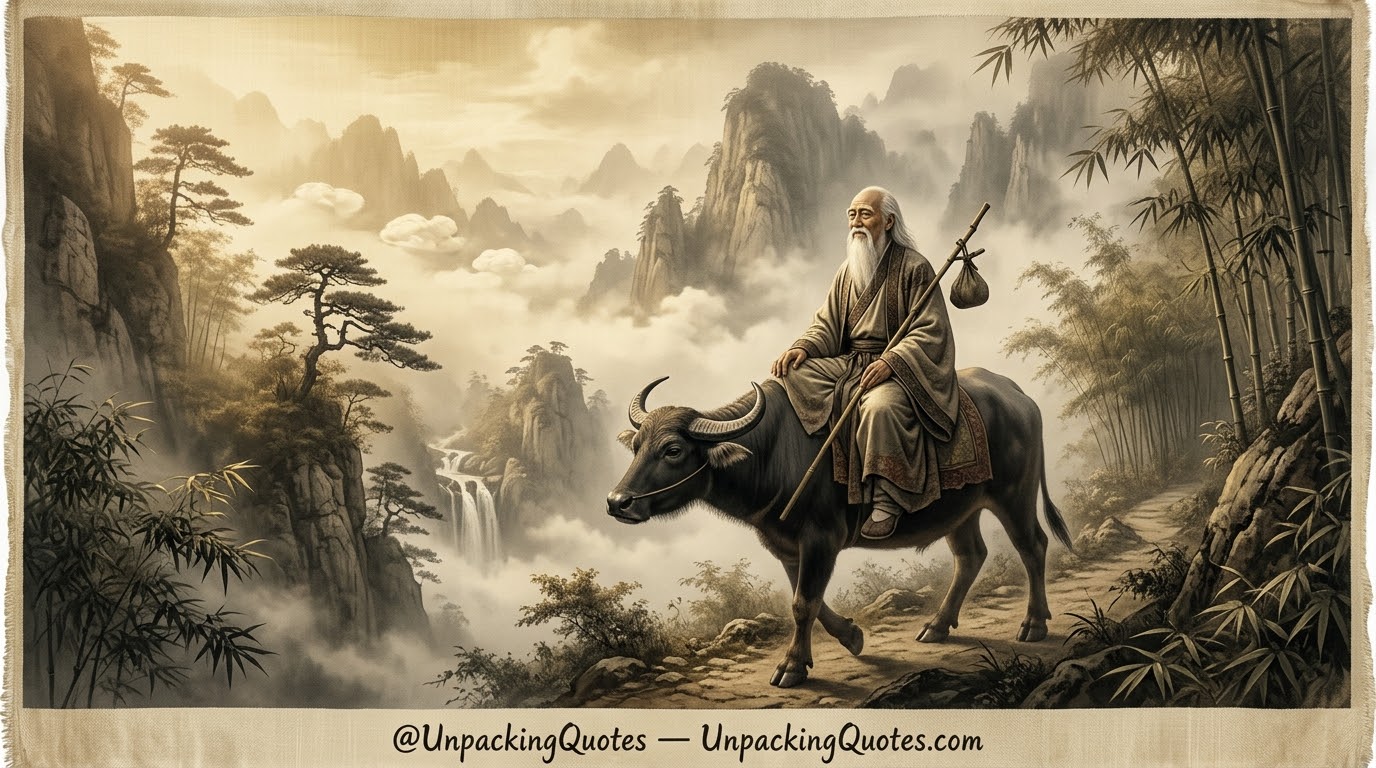
Lao Tzu, also rendered Laozi, is the traditional name associated with the ancient Chinese philosopher credited with the authorship of the Tao Te Ching, one of the foundational texts of Taoism.
Very little can be established with certainty about the historical person behind the name. Traditional accounts place Lao Tzu in ancient China and portray him as a contemporary of Confucius, but modern scholarship generally treats many details of his biography with caution. The name Laozi itself can be understood as “Old Master,” and it may refer to a historical teacher, a literary figure, or a tradition that developed around an earlier sage.
The Tao Te Ching is a remarkably concise work consisting of short passages concerned with the Tao, or “Way,” and with how human beings might live in harmony with the natural order of existence. Its teachings frequently emphasize simplicity, humility, restraint, patience, non-contention, and acting without unnecessary force.
The famous “thousand miles” saying is traditionally associated with Chapter 64 of the Tao Te Ching. The commonly quoted English wording is a translation or adaptation rather than a phrase Lao Tzu originally wrote in English. As with many ancient texts translated across languages and centuries, different translations vary considerably in their wording while preserving the underlying idea.
3. Historical Context and Culture
The Tao Te Ching emerged from the intellectual world of ancient China, traditionally associated with the late Zhou period. This was an era marked by political instability, competing states, social upheaval, and intense philosophical reflection about how individuals and societies should live.
Against this background, early Taoist thought often questioned the assumption that greater effort, greater control, and greater complexity necessarily produce better results. Instead, it frequently pointed toward simplicity, moderation, humility, patience, and alignment with the natural course of things.
Chapter 64 develops this idea through observations about how things develop. A large tree grows from a tiny shoot; a high tower begins with a small foundation; a long journey begins with a first step. The larger achievement is therefore already implicit in the humble beginning.
The passage is also concerned with the difficulty of preventing problems before they become large. Something manageable at its beginning can become difficult when allowed to develop unchecked. The broader lesson is that wise action pays attention to beginnings.
This gives the famous sentence more depth than the motivational interpretation it often receives today. It is not merely an encouragement to “start chasing your dreams.” Within its original philosophical context, it belongs to a larger reflection on beginnings, development, foresight, and the importance of acting before complexity overwhelms us.
4. Relevance Today
The wisdom of this quote remains remarkably applicable because modern life constantly presents us with goals that appear too large to tackle.
Writing a book begins with a page. Learning a language begins with a word. Building a healthier life begins with one decision. Repairing a relationship may begin with one honest conversation. Creating a business begins with one useful idea put into action.
The same principle applies to personal development. We often postpone action because we believe we need to become more prepared before we begin. But preparation itself can become a form of avoidance when it continually replaces action.
The quote offers another way to approach difficult goals: reduce the distance between intention and action. Instead of asking, “How will I accomplish all of this?” ask, “What is the next step?”
That question is powerful because it transforms an abstract ambition into something concrete. The destination may remain distant, but the next step is usually within reach.
It also provides a healthier understanding of progress. A person who takes one meaningful step today may appear to have accomplished very little. But repeated over weeks, months, and years, small actions can produce extraordinary results.
In an age of instant results and visible success, Lao Tzu’s wisdom reminds us that meaningful change often operates on a different timetable. Growth is usually incremental before it becomes visible.
5. Summary
“The journey of a thousand miles begins with a single step” is a reminder that every substantial accomplishment has a beginning that is smaller than the achievement itself.
The quote encourages us not to be intimidated by the distance between where we are and where we want to be. We do not need to complete the entire journey today. We need to take the next step.
Its deeper wisdom, however, goes beyond motivation. It calls our attention to beginnings: to the small actions, decisions, habits, and choices from which larger consequences eventually emerge.
A thousand miles can seem impossible when viewed as a single distance. One step is not.
The journey becomes possible when we begin.
Explore Similar Quotes
Browse the Author Collection
Practicing the Wisdom of the Quote
The practical lesson of Lao Tzu’s saying is straightforward: stop measuring the entire distance and identify the next step.
When a goal feels overwhelming, break it down until the next action becomes clear. You do not need to solve the entire problem before beginning. You need to identify what can reasonably be done now.
Instead of saying:
“I need to completely change my life,”
ask:
“What is one thing I can do today that moves me in the right direction?”
- Is your goal to write a book? Write the first paragraph.
- If your goal is to learn a language, learn one useful expression.
- Do you want to become physically stronger? Complete today’s workout.
- If you want to repair a relationship, make the call.
- If the goal is a major project, complete the first small task.
The action may be small, but it changes your position: you are no longer merely intending to begin. The important distinction is between thinking about beginning and actually beginning.
Begin Before You Feel Completely Ready
Perfectionism often disguises itself as preparation. We tell ourselves that we need more knowledge, more time, more confidence, or better circumstances.
Sometimes preparation is necessary. But eventually preparation must give way to action.
The first step does not require certainty about every subsequent step. Beginning can generate information that planning alone cannot provide.
Make the Next Step Small Enough to Take
A useful question is:
“What is the smallest meaningful action I can take today?”
The word “meaningful” matters. The objective is not to stay busy with trivial tasks but to identify an action that genuinely moves the larger project forward.
Small does not mean insignificant. Small actions become powerful when they are repeated.
Focus on Consistency Rather Than Drama
A dramatic beginning can feel exciting, but sustainable progress usually depends on ordinary repetition.
One workout will not transform your body. One day of studying will not make you fluent. One page will not make a book.
But one workout repeated regularly, one study session after another, and one page written consistently can eventually produce a result that seemed impossible at the beginning.
The first step matters because it begins a sequence.
Do Not Demand the Whole Roadmap
Sometimes we refuse to begin because we cannot see the entire path.
But many journeys reveal themselves progressively. After taking the first step, the second becomes clearer. After the second, the third may become visible.
This does not mean planning is unnecessary. It means that planning should serve action rather than become a substitute for it.
Apply the Principle to Difficult Changes
The principle is particularly useful when facing a change that feels emotionally or practically difficult.
Instead of saying, “I need to completely change my life,” identify one behavior that would represent movement in the right direction.
Instead of “I need to become more disciplined,” decide what you will do tomorrow morning.
Instead of “I need to get my finances under control,” identify the first expense, account, or decision that needs attention.
The objective is to convert an overwhelming abstract problem into a concrete next action.
A Simple Daily Practice
At the beginning or end of each day, choose one question:
What is my next step?
Write down one answer.
Then take that step.
At the end of the day, ask:
Did I move forward?
If the answer is yes, even modestly, the day has contributed to the journey.
A useful daily practice is the One-Step Rule:
- Identify one meaningful goal.
- Reduce it to the smallest useful action.
- Do that action today.
- Repeat tomorrow.
- Let consistency create the distance.
The wisdom of Lao Tzu is not that every step must be large. It is that the journey cannot happen without steps.
Start small. Keep moving. Let the distance take care of itself.
Poetry & Lyrics Inspired by the Quote
A Single Step
The road does not ask
how far you have to go.
It does not demand
that you see the mountain’s end
before you leave the valley.
It waits.
Beneath your feet
is the beginning.
One step through uncertainty,
one step beyond yesterday,
one step taken
when the destination
still hides beyond the horizon.
The road is not crossed
in a single stride.
It is crossed
in mornings and evenings,
in courage and doubt,
in falling and rising again.
A thousand miles
are only a thousand miles
when you look at them all at once.
Look instead
at the ground before you.
There—
the next step.
Take it.
And when the road
turns beyond your sight,
take another.
For every distant place
was once
a place you had not yet begun to reach.
And every great journey
was once
only this:
a person standing still,
then moving.
One step.