
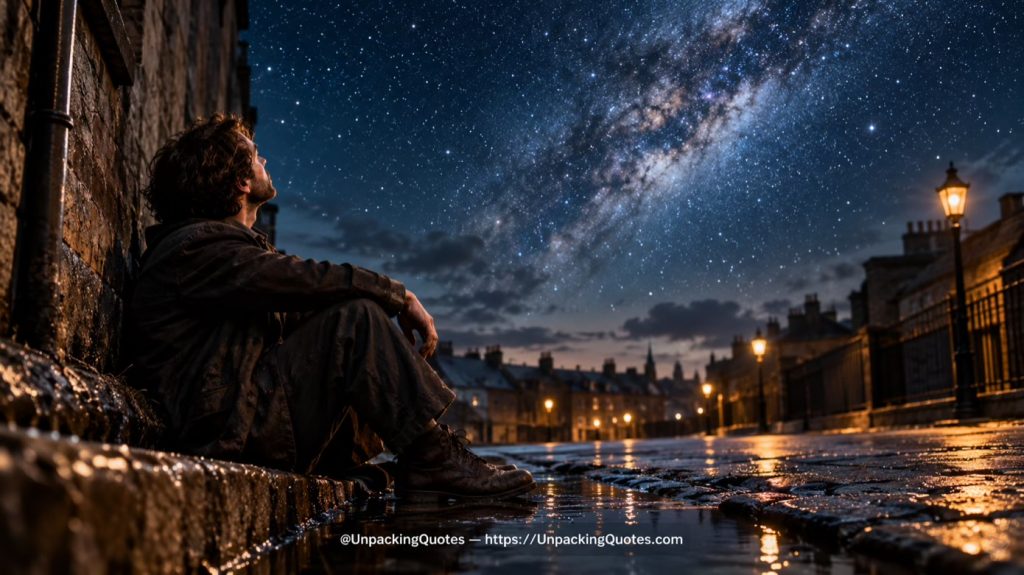
“We Are All in the Gutter” — Meaning of Oscar Wilde’s Quote
“We are all in the gutter, but some of us are looking at the stars.”
— Oscar Wilde
1. Meaning of the Quote
Oscar Wilde's famous line presents a striking contrast between the lowest conditions of human existence and the highest things the human imagination can contemplate. The gutter represents hardship, disappointment, humiliation, moral imperfection, and the less admirable realities of life. The stars represent beauty, aspiration, possibility, and the ability to recognize something greater than one's immediate circumstances.
The force of the sentence lies in its refusal to choose between these two realities. Wilde does not suggest that some people live entirely free from difficulty while others are condemned to suffer. Instead, the opening words place everyone in the same metaphorical gutter. The difference emerges in the second half: while we may share the limitations of human existence, we do not all direct our attention toward the same things.
To look at the stars is to preserve a sense of possibility even when life is imperfect. A person may experience failure without abandoning ambition, endure disappointment without surrendering the capacity to love, or recognize personal weaknesses without giving up the pursuit of wisdom. The circumstances may remain difficult, but the individual's relationship to those circumstances can still change.
Thinking Positively
This distinction is important because the quote is not simply an invitation to think positively. Looking at the stars does not remove the gutter, nor does admiration for something beautiful automatically solve a practical problem. Rather, the image suggests that our present condition need not determine the full range of what we can imagine, value, or pursue. Hope becomes meaningful when it helps us see beyond our limitations without pretending those limitations do not exist.
The stars also suggest a form of intellectual and moral independence. People can become so absorbed in immediate concerns—status, money, resentment, embarrassment, or the opinions of others—that they lose sight of more enduring values. Looking upward represents the ability to step back from these pressures and ask what deserves our attention. It is a reminder that a person's circumstances and a person's aspirations are not necessarily the same thing.
There is, however, a subtle tension in the quotation. Looking at the stars may express courage and vision, but it may also reveal the distance between what we desire and what we actually achieve. The sentence does not promise that every dream will come true. Its deeper appeal lies in the possibility of retaining perspective and aspiration even when the path forward remains uncertain.
Ultimately, Wilde's words invite us to consider not only where we stand but also what we choose to see from where we stand. We cannot always control the difficulties that surround us, but we can work to prevent those difficulties from becoming the entire horizon of our lives.
The central lesson
Do not confuse your present circumstances with the limits of your possibilities. Acknowledge the ground beneath your feet, but do not lose sight of the things that make life worth improving.
2. About the Author: Oscar Wilde
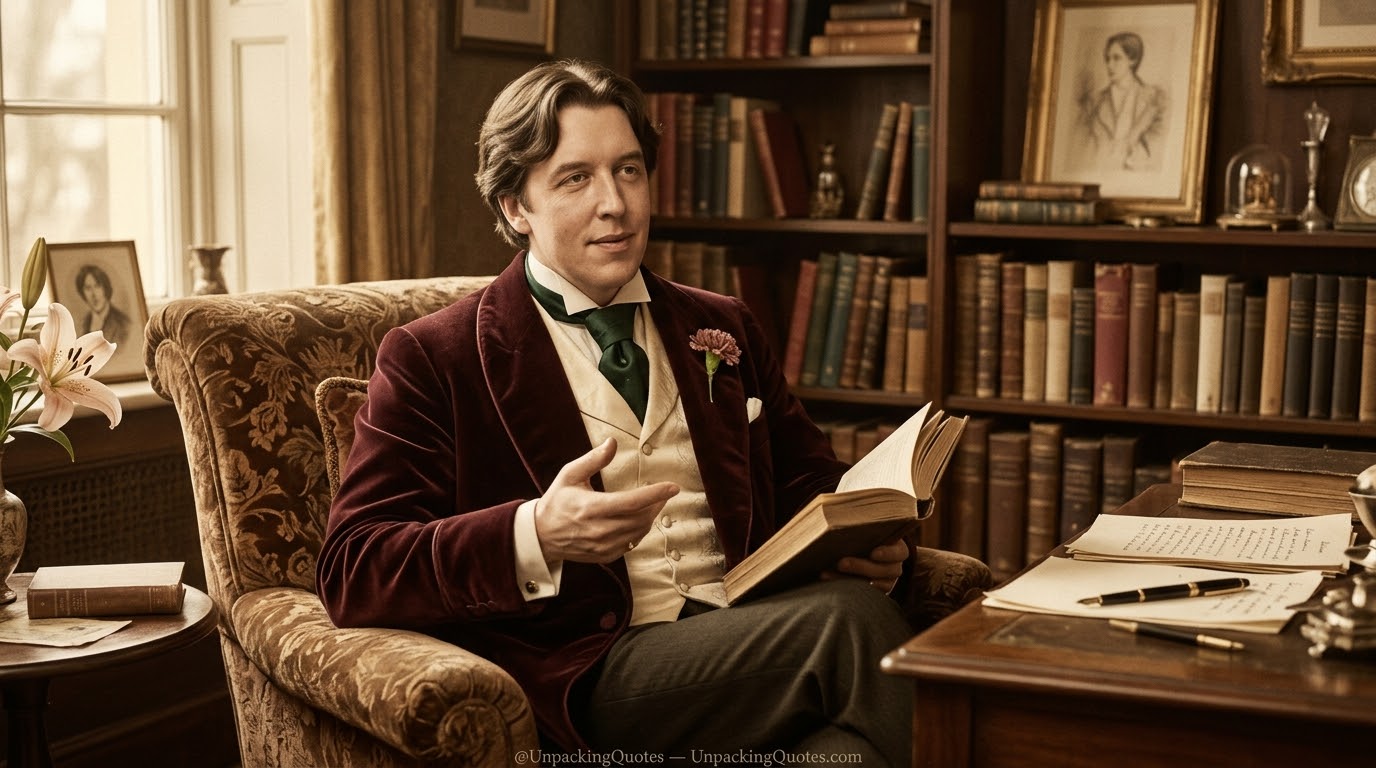
Oscar Wilde (1854–1900) was an Irish writer, poet, dramatist, and essayist renowned for his wit, aesthetic sensibility, and criticism of Victorian social conventions. His literary style frequently used paradox, irony, and carefully constructed contradictions to expose the gap between public respectability and private reality.
His best-known works include The Picture of Dorian Gray, The Importance of Being Earnest, and Lady Windermere’s Fan.
Wilde was educated at Trinity College Dublin and Oxford, where he developed his interests in classical literature, art, and aesthetics. He subsequently became a prominent figure in London's literary and cultural life. His public persona, elegant conversation, and memorable epigrams made him a celebrated but controversial figure in late nineteenth-century British society.
Beneath his polished wit, Wilde's writing often examined hypocrisy, reputation, desire, social judgment, and the complicated relationship between morality and appearances. His characters frequently say things that sound definitive but become more ambiguous when considered in context. That quality is central to understanding this quotation: its apparent optimism is complicated by the character who speaks it and the circumstances of the scene.
Wilde's life also illustrates the vulnerability of an individual who challenges prevailing social expectations. In 1895, he was convicted of gross indecency under the laws of the time and imprisoned. Following his release, he lived largely in exile in France, where he died in 1900. His literary reputation has endured, in part because his explorations of social conformity, personal freedom, and human contradiction continue to resonate with modern readers.
It would be misleading, however, to interpret every memorable line in Wilde's works as a direct statement of his personal philosophy. His plays are dramatic constructions in which characters have their own motives, blind spots, and rhetorical styles. To understand a quotation fully, we must consider not only its author but also the fictional voice and situation through which it is expressed.
3. Historical Context and Culture
The quotation comes from Lady Windermere’s Fan, a four-act comedy by Oscar Wilde that premiered in London in February 1892 and was published in 1893. The play belongs to the world of late-Victorian society, where social position, reputation, marriage, and public morality could exert enormous influence over private life. Wilde used the conventions of drawing-room comedy to expose the contradictions beneath the polished surface of respectable society.
The original setting matters because the line is often presented today as a straightforward statement about optimism. In the play, however, it emerges from a conversation among upper-class men discussing virtue, vice, and relationships. Lord Darlington delivers the remark after the men exchange cynical observations about human behavior. His companions immediately tease him for sounding unusually romantic, and the conversation reveals that he is in love with a married woman.
This dramatic situation gives the quotation a more complicated meaning. Lord Darlington's reference to the stars can suggest a capacity to see beauty and goodness beyond ordinary life, but it also reflects his romantic idealization of a woman whose circumstances make her unavailable to him. His language is therefore both appealing and potentially self-serving. The audience has reason to question whether his elevated vision reflects genuine wisdom, romantic longing, or a mixture of the two.
Wilde's treatment of morality is equally important. Victorian society often distinguished sharply between respectable appearances and supposedly immoral behavior, particularly when judging women. The play challenges such simple classifications through characters whose actions reveal unexpected generosity, sacrifice, selfishness, and misunderstanding. Its moral world is more complicated than its characters' public reputations suggest.
The quotation's enduring appeal comes partly from this tension between its immediate dramatic purpose and its broader symbolic possibilities. Readers can understand the stars as an image of aspiration without forgetting that the words originally belong to a character with personal motives. Wilde's skill lies in allowing a memorable sentence to remain meaningful beyond its original scene while preserving the irony that gives it literary depth.
4. Relevance Today
In contemporary life, the contrast between the gutter and the stars remains a useful way to think about adversity, ambition, and perspective. People encounter setbacks in their careers, relationships, finances, education, and personal development. During difficult periods, the immediate problem can become so consuming that it begins to define the whole future. Wilde's image challenges that narrowing of vision.
In personal adversity, the quotation encourages people to distinguish between experiencing a difficult situation and defining themselves by it. Losing a job, making a serious mistake, or facing a painful disappointment can affect a person's circumstances without erasing every ability, relationship, or opportunity they possess. Looking toward the stars means recognizing that the present chapter is not necessarily the final account of a life.
In the pursuit of ambition, the stars can represent goals that demand patience and sustained effort. A student can continue learning despite poor results. An entrepreneur can revise a failing strategy rather than abandon every long-term objective. Someone rebuilding a relationship can acknowledge past mistakes while working toward a healthier future. In each case, aspiration becomes useful when it informs concrete decisions instead of remaining a comforting fantasy.
In relationships and moral judgment, the quotation also invites a more generous understanding of human imperfection. People are rarely defined entirely by their worst decisions or their most admirable intentions. Recognizing this complexity does not mean excusing harmful behavior or abandoning accountability. It means leaving room for growth, understanding, and the possibility that a person's future conduct may differ from the past.
In the digital age, the contrast takes on another dimension. Social media can encourage people to compare their private struggles with the polished public lives of others. Such comparisons make it easy to imagine that everyone else is already among the stars while we alone remain in the gutter. Wilde's opening words offer a corrective: human difficulty is more widely shared than public appearances reveal. What differs is not simply who suffers, but how people respond to their circumstances and what they choose to pursue.
Yet the quotation should not be used to suggest that perspective alone can overcome every obstacle. Poverty, discrimination, illness, bereavement, and other serious difficulties may require material assistance, collective action, professional support, or substantial changes in circumstances. Telling someone to look at the stars is not a substitute for helping them out of the gutter.
The most constructive modern interpretation therefore combines hope with responsibility. We can acknowledge suffering without glorifying it, maintain ambition without denying reality, and pursue better conditions without treating present difficulties as proof of personal failure.
5. Summary
Oscar Wilde's quotation endures because it captures a fundamental tension in human life: we are vulnerable to hardship, yet capable of imagining something beyond it. The gutter represents the limitations and imperfections we share; the stars symbolize the aspirations, values, and possibilities that keep those limitations from becoming our entire identity.
The original dramatic context adds an important qualification. Spoken by Lord Darlington in Lady Windermere’s Fan, the line is part of Wilde's exploration of romantic idealism, social morality, and human contradiction—not simply a motivational slogan.
Its lasting wisdom lies in the balance between realism and aspiration. We should see our circumstances clearly, accept responsibility for our choices, and take practical steps to improve what we can. At the same time, we should resist the belief that present hardship exhausts the possibilities of the future.
The essential message is this: where you are in life matters, but it does not have to determine everything you hope to become.
Explore Similar Quotes
Browse the Author Collection
Practicing the Wisdom: Keep Your Eyes on the Stars
Understanding Wilde's quotation is one thing; applying it to daily life is another. It is easy to admire the idea of hope when circumstances are favorable. The real test comes when disappointment, uncertainty, or frustration makes it difficult to imagine a better future.
Practicing this wisdom does not mean pretending that everything is fine. It means learning to recognize difficulty without allowing it to consume our entire field of vision. The following practices translate the quotation into habits of reflection, decision-making, and action.
Seven Practices for Everyday Life
Day 1 — Name the Gutter Without Becoming It
Choose one difficulty that is weighing on you. Describe it as accurately as possible, separating the facts from the conclusions you have drawn about yourself.
For example, "I made a mistake in an important decision" describes an event. "I always fail at everything" turns that event into a judgment about your entire identity.
Practice: Write down one difficult reality and one thing it does not prove about you.
Reflection: Am I describing my situation, or am I allowing it to define who I am?
Day 2 — Identify Your Stars
Consider what gives direction and meaning to your life. Your stars might be a relationship worth nurturing, knowledge you want to acquire, work you believe matters, a personal quality you want to develop, or a contribution you hope to make.
Try to distinguish genuine aspirations from goals pursued mainly to impress others. A meaningful direction should reflect your considered values, not merely the expectations of your surroundings.
Practice: Write down three things you want your life to stand for, regardless of your present circumstances.
Reflection: What remains important to me even when life is difficult?
Day 3 — Change the Question
When facing a setback, the question "Why does this always happen to me?" can reinforce helplessness. A more productive question is, "Given what has happened, what can I do next?"
This does not mean every problem has an easy solution. Some situations require patience, acceptance, outside help, or a change in expectations. The purpose is to identify the next useful response rather than become trapped in repeated frustration.
Practice: Take one unresolved problem and identify a single realistic action you can complete within the next 24 hours.
Reflection: What part of this situation is within my influence?
Day 4 — Look Beyond Appearances
Do not assume that other people are free from difficulties simply because their lives look successful. Their visible achievements may coexist with private struggles you cannot see.
Likewise, resist the temptation to measure your progress against someone else's most impressive moments. A fairer comparison is between your current choices and the person you are trying to become.
Practice: Notice one comparison that makes you feel inadequate. Replace it with a specific measure of your own progress.
Reflection: Am I judging my whole life against a partial picture of someone else's?
Day 5 — Turn Hope Into Work
Hope becomes more durable when it is connected to action. A goal that matters to you deserves a practical step, even if the ultimate result remains uncertain.
You may not be able to transform your circumstances immediately, but you can often learn a skill, seek advice, make a plan, repair a mistake, or establish a better routine.
Practice: Spend 20 minutes working toward one meaningful goal. Focus on the effort rather than the immediate result.
Reflection: What small action would make my desired future more possible?
Day 6 — Recognize the Stars in Ordinary Life
The stars need not represent extraordinary success. They can be found in an honest conversation, an act of kindness, a moment of beauty, a new understanding, or the satisfaction of doing something well.
When life becomes difficult, attention can become fixed on what is missing. Deliberately noticing what remains valuable can restore perspective without denying pain.
Practice: At the end of the day, record three things that were worthwhile. Be specific rather than relying on general statements.
Reflection: What goodness or possibility might I be overlooking because I am preoccupied with difficulty?
Day 7 — Build a Direction, Not a Fantasy
Return to the difficulty you identified on Day 1 and the aspirations you listed on Day 2. Ask how the two can coexist in a realistic plan.
You do not need to solve everything at once. A direction can be meaningful even when progress is slow, and revising a plan can be an act of sound judgment rather than a sign of defeat.
Practice: Write a simple plan containing one difficulty to address, one goal to pursue, and three actions for the coming week.
Reflection: How can I acknowledge where I am while continuing to move toward where I want to be?
The Daily Habit: A Two-Minute Perspective Check
Once a day, pause and answer these three questions:
- The ground: What reality do I need to face honestly today?
- The stars: What value, possibility, or goal deserves my attention?
- The next step: What practical action can I take now?
This brief exercise brings together the three essential elements of the quotation: awareness of difficulty, a vision beyond the present, and a willingness to act.
Final Reflection
Looking at the stars is not an escape from responsibility. It is a way of preserving direction while dealing with reality. The aim is not to become someone who never feels discouraged, but someone who can experience discouragement without surrendering every meaningful possibility.
You may not choose every circumstance that shapes your life. You can, however, work toward a wiser response, seek support when necessary, and continue building a life guided by values rather than governed entirely by setbacks.
The practice is simple: face the ground honestly, keep your aspirations alive, and take the next worthwhile step.
Poetry & Lyrics Inspired by the Quote
An original poem inspired by Oscar Wilde's quotation
“We are all in the gutter, but some of us are looking at the stars.”
Between the Ground and the Stars
We walk where broken shadows lie,
Where weary footsteps mark the stone,
And sometimes all the distant sky
Seems meant for others, not our own.
The road is rough, the night is long,
The heart grows tired of standing tall;
Yet something whispers, soft but strong,
That darkness does not conquer all.
For dreams are not a shelter built
To hide us from the world below;
They are the courage born of guilt,
The seeds we plant in ground we know.
A hand extended, truth confessed,
A door reopened after pain,
A quiet hour of honest rest,
A will to rise and try again.
The stars do not erase the street,
Nor make the stones beneath us fair;
They offer something more complete:
A reason to keep moving there.
So let us see the world as found,
Its grief, its beauty, and its scars;
Keep both our feet upon the ground,
And still lift up our eyes to stars.
Original Lyrics: “Eyes Above the Ground”
An original, song-inspired piece about resilience, perspective, and hope.
Verse 1
Another day, another mile,
A heavy heart, a borrowed smile.
The road is cracked beneath my feet,
And every dream feels incomplete.
But through the clouds, a light remains,
A distant song beyond the rain.
I may be lost, I may be worn,
But hope can rise before the dawn.
Chorus
I'll keep my eyes above the ground,
Where silent stars are shining out.
The night is real, the road is long,
But I still have a place where I belong.
I cannot change the winds that blow,
Or every seed that will not grow.
But while the sky is open wide,
I'll keep a little hope inside.
Verse 2
I've seen the proud, I've seen the fall,
I've learned that no one has it all.
Behind each door, behind each face,
There's some lost dream, some saving grace.
So let me walk with open eyes,
No need to run, no need to hide.
I'll face the truth, accept the scars,
And find my way beneath the stars.
Bridge
Not every wish will find its wings,
Not every road to better things.
But every step that truth can guide
Can change the way we walk through life.
Final Chorus
I'll keep my eyes above the ground,
And seek the good that can be found.
The night is real, but so are stars,
And hope can travel where we are.
I'll do the work that I can do,
I'll face the old, embrace the new.
With both my feet on solid ground,
I'll keep my eyes above the ground.