

Some Things Are in Our Control and Others Not: : The Stoic Wisdom of Epictetus
“Some things are in our control and others not.”
— Epictetus, Enchiridion, Chapter 1, trans. Elizabeth Carter
1. Meaning of the Quote
“Some things are in our control and others not.”
With these deceptively simple words, Epictetus introduces one of the central principles of Stoic philosophy: the distinction between what belongs to our own agency and what lies outside it. In the fuller passage from the Enchiridion, he identifies our judgments, desires, aversions, intentions, and actions as belonging to us, while placing things such as our body, possessions, reputation, and positions of authority outside our complete control.
The distinction is not an argument for passivity. Epictetus is not telling us to stop caring about the world or to abandon our responsibilities. Instead, he is asking us to direct our effort toward the part of life where our choices can actually make a difference.
Much of human frustration comes from treating external outcomes as though they were personal possessions. We may work diligently and still fail, speak honestly and still face misunderstanding, act generously and still receive no gratitude, or take reasonable precautions and still encounter circumstances we cannot prevent. Epictetus’s insight is that our responsibility lies primarily in how we choose, act, judge, and respond—not in guaranteeing the outcome.
When The Wisdom Becomes Powerful
The wisdom becomes particularly powerful when circumstances are difficult. Instead of repeatedly asking, “Why is this happening to me?” the Stoic asks a more practical question: “What part of this situation is mine to deal with?” That question redirects attention from helplessness toward agency.
The principle also requires intellectual honesty. Some things are partly within our influence without being completely within our control. We can influence another person’s opinion, for example, but we cannot command that person to respect us. We may care for our health, but we cannot guarantee every aspect of our physical condition. Furthermore, we can prepare carefully for an important event, but we cannot dictate the final result.
The practical lesson is therefore not simply “control what you can.” It is more precise: give your effort to what belongs to your agency, and do not make your peace dependent upon what does not.
2. About the Author
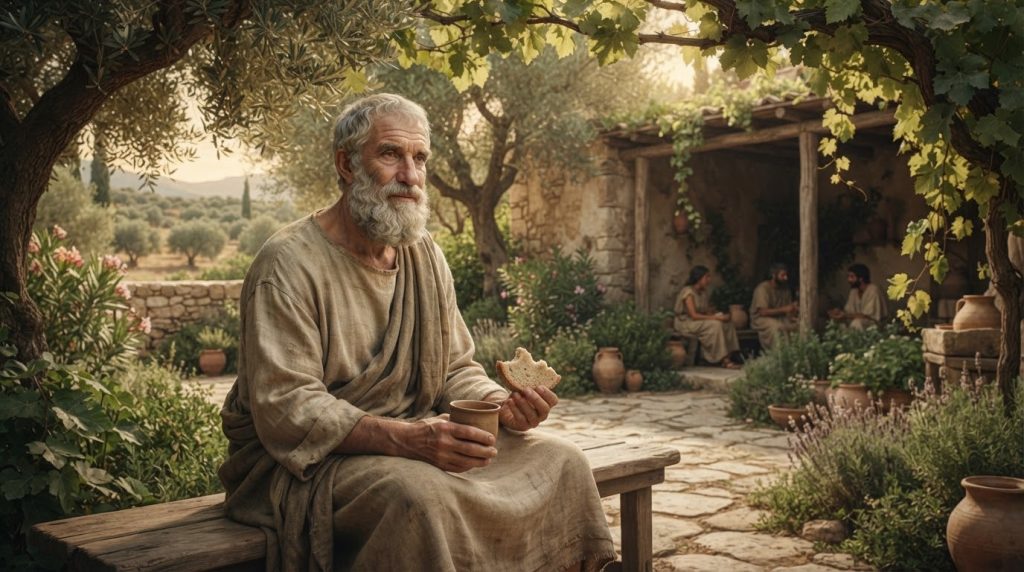
Epictetus (c. 50–135 CE) was a Greek Stoic philosopher who was born in Hierapolis in Asia Minor and later taught philosophy at Nicopolis in Epirus. Unlike philosophers whose surviving works were written in their own hand, Epictetus left no writings himself. His teachings were recorded and organized by his student Arrian.
Two works preserve his philosophy most prominently: the Discourses and the Enchiridion, or “Handbook.” The Enchiridion is a concise collection of principles drawn from his teaching and intended as a practical guide to living rather than merely a theoretical philosophical text.
For Epictetus, philosophy was fundamentally a discipline of living. The purpose of philosophical understanding was to transform how a person judges events, makes choices, handles adversity, and relates to desires and fears.
The opening of the Enchiridion establishes the foundation for this approach: distinguish what is within our power from what is not, and then organize our desires and actions accordingly.
3. Historical Context and Culture
Epictetus lived during the Roman Imperial period, when Stoicism had developed into one of the major philosophical traditions of the Greco-Roman world. Stoic philosophy was concerned not only with abstract questions about reality but also with the practical problem of how a human being could live well in a world containing uncertainty, loss, suffering, social inequality, and death.
The distinction between what is “in our control” and what is not reflects a broader Stoic concern with human agency. In the Enchiridion, Epictetus places judgments, desires, aversions, and one’s own actions on the side of what belongs to us, while placing external conditions such as possessions, reputation, and offices outside that category.
This distinction was especially meaningful in a world in which an individual’s circumstances could change dramatically through political decisions, social status, illness, financial loss, exile, or the actions of powerful people. Stoicism sought a form of freedom that could not depend entirely upon favorable external circumstances.
The Enchiridion was not written by Epictetus himself. It was compiled by Arrian from Epictetus’s teaching, making it important to distinguish the historical philosopher from the later written record of his words. The passage is nevertheless firmly associated with Epictetus and appears as the opening chapter of the Enchiridion.
4. Relevance Today
The distinction Epictetus draws remains remarkably applicable to modern life because technological progress has not eliminated uncertainty or our dependence upon circumstances beyond our control.
At work, we can control the quality of our preparation and effort, but not every decision made by an employer or colleague. In relationships, we can control whether we communicate honestly and respectfully, but we cannot control another person’s feelings or choices. In public life, we can participate, speak, vote, and act according to our principles, but we cannot personally determine every outcome.
The same principle applies to everyday disappointments. Traffic, weather, delays, criticism, other people’s behavior, and unexpected changes can consume enormous amounts of emotional energy when we demand that reality conform to our preferences.
Epictetus offers another approach: identify the part of the situation that actually belongs to you. Then act there.
This does not mean that external circumstances are irrelevant. Some external conditions are genuinely important and require action. The Stoic distinction is about where to place one’s agency—not about pretending that circumstances have no consequences.
5. Summary
Epictetus’s opening principle is a lesson in directing human effort wisely. We cannot command everything that happens to us, but we can exercise judgment about what happens, choose our responses, regulate our desires, and decide how we act.
The deeper message is about freedom. When our peace depends upon controlling people, circumstances, reputation, possessions, or outcomes that cannot ultimately belong to us, we become vulnerable to everything that can change them.
When we instead concentrate on what genuinely belongs to our agency, difficult circumstances may still be difficult, but they no longer have the same power to determine the quality of our character or the direction of our response.
The Stoic question is therefore simple and enduring:
What is mine to choose, and what must I learn to accept?
Explore Similar Quotes
Browse the Author Collection
Practicing the Wisdom of the Quote
The value of Epictetus’s teaching appears when it becomes a habit rather than merely an idea. The goal is to develop the reflex of separating what belongs to our agency from what does not before frustration, fear, or anger takes over.
1: Ask the Control Question
When something goes wrong, pause before reacting and ask:
“What part of this situation is actually within my control?”
Then divide the situation into two categories.
Within my control:
My judgment, words, choices, preparation, effort, attitude, boundaries, and actions.
Outside my complete control:
Other people’s opinions, decisions, reactions, past events, unexpected circumstances, and final outcomes.
Once the distinction is clear, put your energy into the first category.
2: Separate Effort from Outcome
A common source of frustration is judging ourselves entirely by results.
Instead, evaluate the quality of your contribution. Did you prepare carefully? Did you act honestly? Did you make a reasonable effort? Did you respond with patience and courage?
An outcome can be disappointing without proving that the effort was worthless. The result may depend upon factors that were never completely yours to command.
3: Notice When You Are Trying to Control Another Person
Ask yourself:
“Am I trying to control someone’s choice, opinion, emotion, or response?”
If the answer is yes, redirect your attention toward what you can actually do. You can explain yourself, listen, establish a boundary, apologize, encourage, or walk away. You cannot manufacture another person’s response.
4: Use the Pause Before Reacting
When faced with criticism, bad news, frustration, or an unexpected event, create a small space between the event and your response.
Take a breath. Name what happened. Then ask:
“What belongs to me here?”
That brief pause can transform a reflexive reaction into a deliberate response.
5: Prepare Without Demanding Certainty
Epictetus does not teach us to stop planning. Quite the opposite: preparation is part of responsible action.
Prepare thoroughly, but recognize that preparation does not purchase certainty. You can plan a journey without controlling the weather. You can prepare for a conversation without controlling how another person receives it. You can work toward a goal without possessing the final result.
Preparation belongs to you. Certainty does not.
6: Release the Need for External Validation
Reputation is one of the external things Epictetus places outside our complete control. That does not mean reputation has no practical consequences; it means that another person’s judgment cannot become the foundation of your inner stability.
Ask instead:
“Did I act according to the standards I believe are right?”
This shifts the center of evaluation from applause to character.
A Daily Stoic Exercise
At the beginning of the day, identify three things you can influence and three things you cannot control.
At the end of the day, ask:
- Where did I focus my energy wisely?
- Where did I waste energy trying to control an outcome?
- What response would better reflect my values tomorrow?
Practiced consistently, this exercise can make the distinction between agency and circumstance increasingly automatic.
A Simple Reminder
When frustration rises, remember:
I cannot control everything that happens.
I can control what I choose to do next.
That is the practical heart of Epictetus’s teaching.
Poetry & Lyrics Inspired by the Quote
What Belongs to Me
I cannot command the turning sky,
or ask the restless wind to wait.
I cannot make another heart
choose love, forgive, or change its fate.
I cannot call the past undone,
or make tomorrow reveal its face.
I cannot hold the world in place
or make uncertainty give way.
But here, within this breath I take,
a smaller kingdom still remains:
the words I choose, the steps I make,
the courage rising through the pain.
I cannot choose each road ahead,
nor every stone beneath my feet.
But I can choose the way I walk,
and meet the moment without retreat.
Let others carry what is theirs.
Let changing fortunes come and go.
My task is not to master life,
but master how I meet its flow.
So when the world refuses me
the certainty I thought I knew,
I’ll ask not, “Why won’t this obey?”
but, “What is mine for me to do?”
And there, within that quiet space
between the circumstance and me,
I may discover something rare:
the freedom to choose who I will be.