
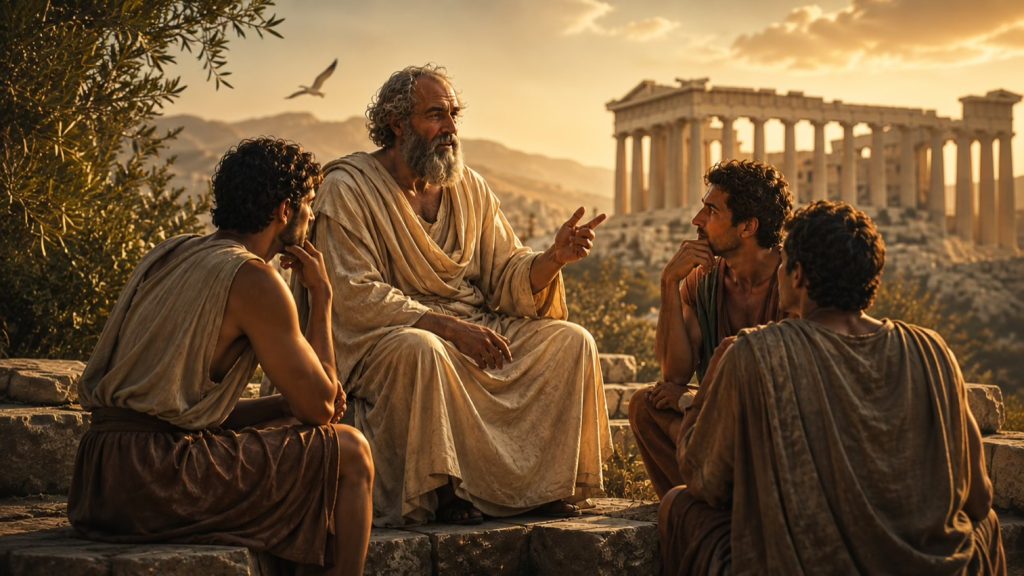
Practice & Application
The easiest way to apply this quotation is to replace the habit of immediately seeking answers with the habit of first asking better questions.
When you encounter an important idea, don’t simply ask, “What is the answer?” Ask, “How can I understand this for myself?”
When someone gives you advice, explore the reasoning behind it. When you disagree with someone, ask what assumption produces the disagreement. When you make a mistake, don’t stop at “What went wrong?” Ask, “What did this experience reveal that I didn’t understand before?”
You can also practice Socratic thinking in your own daily decisions. Before accepting one of your strongly held beliefs, challenge yourself to explain why you believe it. Then deliberately look for evidence that could prove you wrong.
And when teaching someone else—especially a child—resist the temptation to provide every answer immediately. Ask questions that help them reason their way toward an answer.
Instead of saying, “This is how you do it,” try asking, “What do you think would happen if we tried this?”
Instead of correcting immediately, ask, “What makes you think that?”
Instead of ending a conversation with an answer, sometimes leave the person with a question worth thinking about.
The objective is not to make people dependent upon our knowledge.
It is to help them develop their own.
A Poem Inspired by the Quote
The Question
Do not give me every answer,
leave a question in my hands;
let me turn it in the silence,
let me see where understanding stands.
Do not tell me where the road ends,
teach me how to read the sky;
give me courage to keep walking,
and the freedom to ask why.
A thought awakened from within
is worth more than words repeated;
truth becomes a deeper thing
when by our own search it is completed.
So ask me what I cannot see,
challenge what I think I know;
let uncertainty become the seed
from which wiser questions grow.
For knowledge may be handed down,
but wisdom asks us to participate.
And sometimes the greatest teacher
is not the one who tells us what is true—
but the one
who makes us
think