
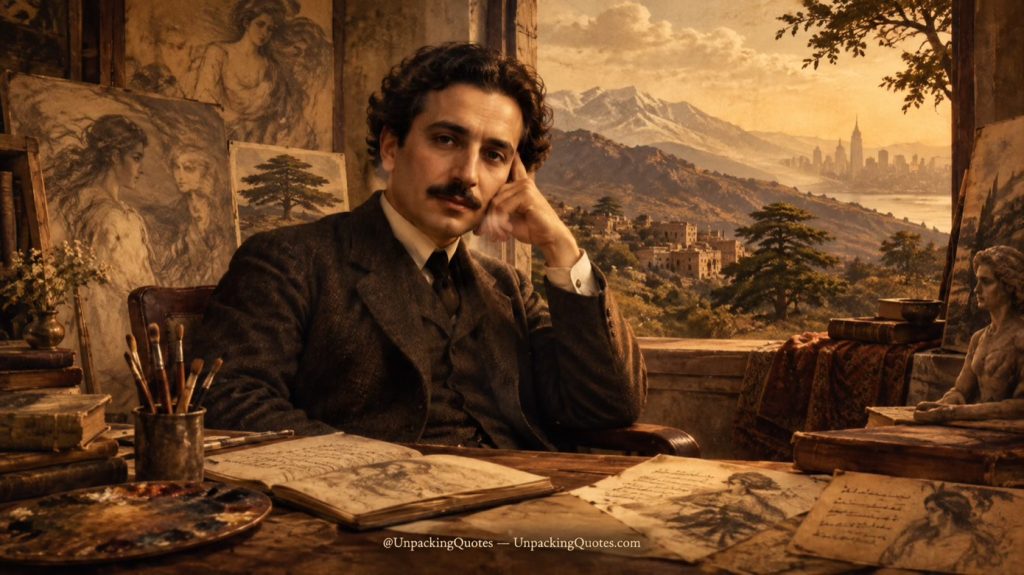
Khalil Gibran Biography and Life Summary
"Your joy is your sorrow unmasked. And the selfsame well from which your laughter rises was oftentimes filled with your tears."
— Kahlil Gibran
Overview & Quick Summary
Kahlil Gibran was a Lebanese-American writer, poet, philosopher, and visual artist whose lyrical prose and deeply spiritual philosophical insights bridged the cultural worlds of East and West. Best known for his 1923 masterpiece The Prophet—a collection of poetic essays delivered through the fictional seer Almustafa—Gibran became the third best-selling poet of all time (behind Shakespeare and Laozi). His multidimensional art explored love, sorrow, freedom, work, friendship, and the unity of human experience across spiritual traditions.
Key Life Events & Context
Khalil Gibran was born in the village of Bsharri in Mount Lebanon (then part of the Ottoman Empire). He spent his early childhood immersed in the natural beauty of the Cedars of Lebanon. In 1895, his mother immigrated with Gibran and his siblings to Boston’s South End. Discovered for his artistic talent by photographer F. Holland Day, Gibran was sent back to Beirut for formal studies in Arabic literature and college-level arts. He later studied painting in Paris under Auguste Rodin before settling in New York City, where he helped found the Pen League (Al-Rabitah al-Qalamiyyah), a celebrated literary movement of Arab-American writers. Throughout his life in the United States, Gibran painted and wrote in both Arabic and English, leaving behind a massive body of artwork alongside his poetic literature.
Core Philosophy & Major Themes
The Unity of Life & Spirit: Gibran rejected rigid dogmatic boundaries, emphasizing an overarching spiritual oneness that connects all human beings across religions, cultures, and races.
Paradoxes of Human Emotion: His work frequently examines the interconnectedness of opposites—showing how grief expands our capacity for joy, solitude deepens our capacity for love, and work is "love made visible."
Freedom, Autonomy, and Interdependence: In The Prophet, Gibran advocates for balanced relationships—whether in marriage, parenting, or friendship—where individuals stand together like columns supporting a roof, supporting one another without stifling personal identity.
Why His Wisdom Still Matters Today
Kahlil Gibran provides an enduring balm for life's universal transitions and existential questions. His reflections on grief, love, career, parenting, and personal growth remain among the most quoted philosophical passages worldwide, offering a poetic guide for navigating modern life with empathy, grace, and spiritual depth.
NATIONALITY: Lebanese-American.
BIRTH-DEATH-DATE: January 6, 1883 – April 10, 1931.
ERA PERIOD: Early 20th Century, Late 19th Century, Modern Romanticism.
MAIN DISCIPLINE: Philology, Poetry, Visual Arts, Prose Literature.
NOTABLE WORKS: The Prophet (1923), Broken Wings (1912), The Madman (1918), Sand and Foam (1926), Jesus, the Son of Man (1928)
Explore This Author’s Quotes
Click on any quote below to explore its Unpacking — discover its meaning, context, and relevance today.