
Site logo
    • Home
    • Start Here
    • Quotes
      • Browse All the Quotes
      • Share Your Quote
    • Authors
    • About UnpackingQuotes.com
    Sign in
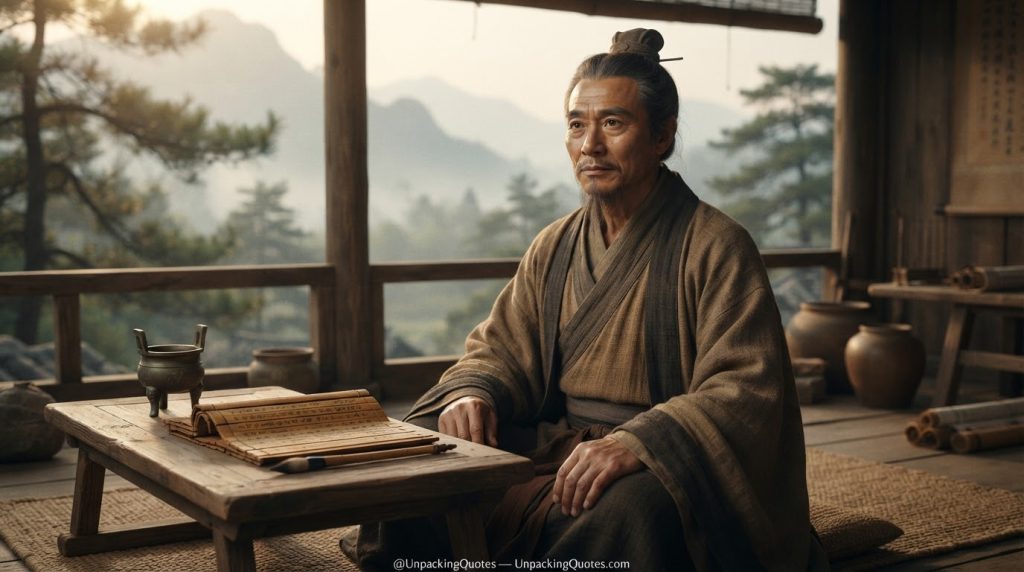
    Confucius: A cinematic, 16:9 historical portrait of Confucius as a mature Chinese man in his late 50s or early 60s, seated in a simple wooden teaching pavilion during the Spring and Autumn period. He has a thoughtful, weathered face with natural skin texture, deep eyes, dark hair with subtle greying gathered in a traditional topknot, and is dressed in layered, muted earth-toned hemp robes. He sits with an upright, calm posture, hands resting naturally, positioned slightly off-center. Before him on a wooden table rests an open bundle of ancient bamboo slips, a writing brush, and a small bronze ritual vessel. The background reveals a misty mountain landscape with pine trees under soft, warm late-afternoon golden light. At the bottom center, the text reads: “@UnpackingQuotes — UnpackingQuotes.com”.

    Confucius Biography & Philosophy | Author Profile

      • Biography
      • Quotes / Works
      • prev
      • next
      • Bookmark
      • Share
      • prev
      • next

      Confucius Biography and Life Summary

      "By three methods we may learn wisdom: First, by reflection, which is noblest; Second, by imitation, which is easiest; and third by experience, which is the bitterest." — Confucius

      Overview & Quick Summary

      Confucius (Kong Fuzi / Master Kong) was an ancient Chinese philosopher, teacher, and political theorist whose ethical, social, and political teachings formed the foundation of East Asian civilization. Operating during a tumultuous era of political instability, Confucius emphasized moral integrity, filial piety, social harmony, and righteous governance. His conversations, aphorisms, and debates were meticulously recorded by his disciples in The Analects, establishing a worldview that guided Chinese culture, government, and education for over two millennia.

      Key Life Events & Context

      Born in the State of Lu (modern-day Shandong province) into a family of noble lineage that had fallen into poverty, Confucius was raised by his mother after his father died during his early childhood. Demonstrating an insatiable appetite for learning, he mastered the traditional Six Arts and served in various administrative government roles, eventually rising to become Minister of Justice in Lu. Disillusioned by political corruption and civil strife, Confucius resigned his position and spent over a decade traveling through neighboring Chinese states with a loyal circle of disciples, offering advice to rulers on ethical governance. Returning to Lu in his final years, he dedicated his remaining life to teaching and editing classical texts.

      Core Philosophy & Major Themes

        •  Ren (Benevolence / Humaneness): The highest virtue in Confucian thought, representing deep empathy, compassion, and respect toward others in daily human interactions.
        •  Li (Ritual / Propriety): The observance of proper etiquette, social norms, and ceremonial traditions that maintain order, respect, and emotional balance within family and society.
        •  Filial Piety (Xiao): Absolute respect, devotion, and care shown toward parents, ancestors, and elders, serving as the fundamental building block for a stable and harmonious society.
        •  The Exemplary Person (Junzi): Confucius urged individuals to strive to become a Junzi—a person of noble character, moral rectitude, and continuous self-cultivation, regardless of social rank or birth.

      Why His Wisdom Still Matters Today

      In a world often fragmented by individualism and social friction, Confucius offers timeless lessons on community duty, mutual respect, relational ethics, and lead-by-example leadership. His emphasis on character-driven education and personal moral responsibility remains deeply relevant for contemporary social, organizational, and family life.

      NATIONALITY: Chinese.
      BIRTH-DEATH-DATE: 551 BC – 479 BC.
      ERA PERIOD: Classical Antiquity, Ancient China.
      MAIN DISCIPLINE: Moral Philosophy, Social Ethics, Political Thought, Education.
      NOTABLE WORKS: The Analects (Lunyu)

      Explore This Author’s Quotes

      Click on any quote below to explore its Unpacking — discover its meaning, context, and relevance today.

      The Man Who Moves a Mountain Begins by Carrying Away Small Stones - Confucius
      He who learns but does not think, is lost. He who thinks but does not learn is in great danger — Confucius

      You May Also Be Interested In

      Johann Wolfgang von Goethe Biography & Philosophy | Author Profile

      Johann Wolfgang von Goethe Biography & Philosophy | Author Profile "Whatever you can do, or dream you…

      J. R. R. Tolkien Biography & Works | Author Profile

      J. R. R. Tolkien Biography & Works | Author Profile "Not all those who wander are lost." — J. R. R.…

      Oscar Wilde Biography & Works | Author Profile

      Oscar Wilde Biography & Works | Author Profile "To live is the rarest thing in the world. Most people…

      Henry David Thoreau Biography & Walden (1854) | Author Profile

      Henry David Thoreau Biography And Life Summary — Author Profile "I went to the woods because I wished to…

      Søren Kierkegaard Biography & Philosophy | Author Profile

      Søren Kierkegaard Biography And Life Summary "Life can only be understood backwards; but it must be lived…

      Lao Tzu Biography & Philosophy | Author Profile

      Lao Tzu Biography & Life Summary "A journey of a thousand miles begins with a single step." —…

      Khalil Gibran Biography and Life Summary

      Khalil Gibran Biography and Life Summary "Your joy is your sorrow unmasked. And the selfsame well from which…

      Phillips Brooks Biography & Life Summary

      Phillips Brooks Biography & Life Summary "Do not pray for easy lives. Pray to be stronger men. Do not…

      Friedrich Nietzsche Biography & Philosophy | Author Profile

      Friedrich Nietzsche Biography & Life Summary "He who has a why to live can bear almost any how." —…

      Albert Einstein Biography & Life Summary

      Albert Einstein Biography & Life Summary "Imagination is more important than knowledge. For knowledge is…

      Epicurus Biography | Ancient Greek Philosopher

      Epicurus Biography and Life Summary "Do not spoil what you have by desiring what you have not; remember that…

      Plato Biography | Athenian Philosopher

      Plato Biography and Life Summary "The beginning is the most important part of the work." — Plato Plato was…

      Socrates Biography | Athenian philosopher

      Overview & Quick Summary of Socrates Biography "An unexamined life is not worth living." —…

      Seneca Biography & Philosophy | Author Profile

      Lucius Annaeus Seneca Biography | Roman Stoic philosopher "Luck is what happens when preparation meets…

      Epictetus Biography | Stoic Philosopher

      Epictetus Biography, Stoic Philosopher "We cannot choose our external circumstances, but we can always…

      Marcus Aurelius Biography | Emperor of Rome

      Marcus Aurelius Biography, Emperor of Rome "You have power over your mind - not outside events. Realize…

      Aristotle Biography | Ancient Greek Philosopher

      Aristotle Biography | Ancient Greek Philosopher "Happiness depends upon ourselves." — Aristotle Overview…

      All quote explanations, interpretations, practices, applications, lyrics, poems, and original creative works published on UnpackingQuotes.com are protected by copyright.

      The lyrics and poems inspired by the ideas, themes, and wisdom of the quotes are original creative works of UnpackingQuotes.com unless otherwise stated.

      © Unpacking Quotes 2026 - All rights reserved
      Unpacking the Quote. Practicing the Wisdom. Creating the Lyrics.

        • Facebook
        • X
        • WhatsApp
        • Viber
        • Telegram
        • Pinterest
        • LinkedIn
        • Tumblr
        • Reddit
        • VKontakte
        • Mail
        • Copy link
        • Share via...
        • Threads
        • Bluesky