
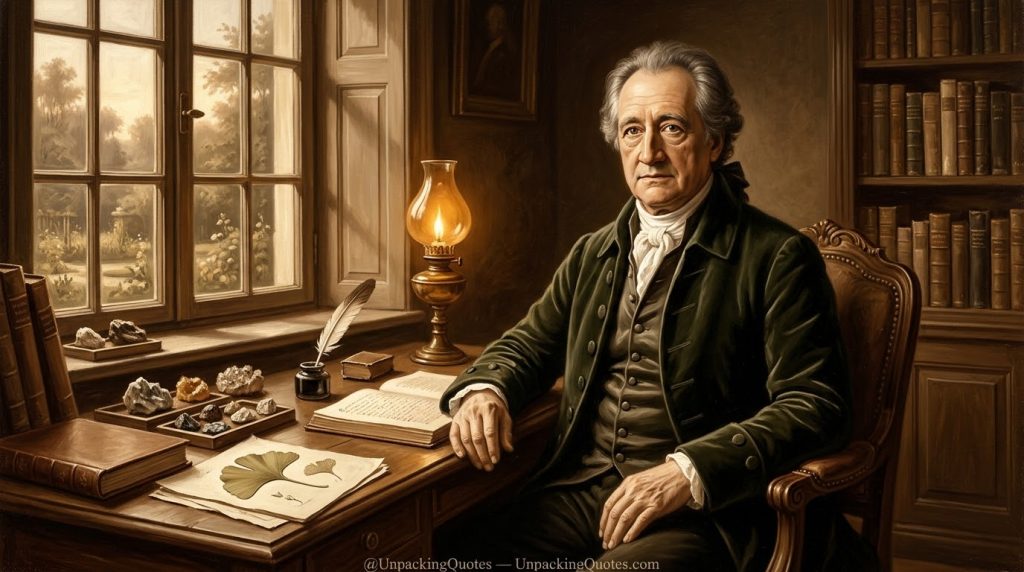
Johann Wolfgang von Goethe Biography & Philosophy | Author Profile
"Whatever you can do, or dream you can, begin it. Boldness has genius, power, and magic in it."
— Johann Wolfgang von Goethe
Overview & Quick Summary
Johann Wolfgang von Goethe was a German polymath, poet, dramatist, and scientist whose monumental contributions defined the pinnacle of Weimar Classicism and shaped modern European literature. Best known for his tragic masterpiece Faust and his groundbreaking epistolary novel The Sorrows of Young Werther, Goethe explored the depths of human passion, artistic striving, and scientific observation. His eclectic intellect bridged the Enlightenment, Sturm und Drang, and Romanticism, establishing him as one of the towering literary figures in Western history.
Key Life Events & Context
Born in Frankfurt am Main into an affluent and cultured family, Goethe received a comprehensive private education in languages, law, and the arts. He studied law in Leipzig and Strasbourg, where he encountered vital literary figures and experienced a profound awakening in his artistic sensibilities. In 1774, international literary stardom arrived overnight with the publication of The Sorrows of Young Werther, a novel that captured the passionate anguish of the Romantic spirit. Invited to the court of Karl August, Duke of Saxe-Weimar-Eisenach in 1775, Goethe settled in Weimar, where he spent the remainder of his life serving as a statesman, director of the court theatre, and tireless researcher in botany, anatomy, and optics—all while producing a lifetime of unmatched poetry and prose.
Core Philosophy & Major Themes
- Striving (Streben) & Self-Transformation: Goethe viewed human existence not as a static state, but as an ongoing, restless drive toward self-perfection, intellectual discovery, and spiritual elevation.
- Holistic Unity of Art and Nature: Rejecting rigid divisions between science and art, Goethe approached botany, optics, and poetry through direct, intuitive observation, seeking the underlying living patterns (Urphänomen) connecting all creation.
- The Duality of Passion and Reason: His works deeply investigate the tension between emotional intensity (Sturm und Drang) and classical harmony, arguing that maturity requires mastering inner chaos through disciplined character and wisdom.
Why His Wisdom Still Matters Today
Goethe provides an enduring model for the Renaissance polymath in a hyper-specialized modern world. His insistence on lifelong curiosity, emotional authenticity, and the harmonious integration of science, art, and human experience offers timeless inspiration for personal growth and creative expression.
NATIONALITY: German.
BIRTH-DEATH-DATE: August 28, 1749 – March 22, 1832.
ERA PERIOD: Weimar Classicism, Romanticism, Enlightenment, 18th–19th Century.
MAIN DISCIPLINE: Natural Science, Statesmanship, Drama, Poetry, Literary Criticism.
NOTABLE WORKS: Faust (Parts I and II), The Sorrows of Young Werther, Wilhelm Meister’s Apprenticeship, Italian Journey, Theory of Colours
Explore This Author’s Quotes
Click on any quote below to explore its Unpacking — discover its meaning, context, and relevance today.